

Calories and Nutritions in Rice Paper
Rice paper looks almost too delicate to be taken seriously as food. A dry, translucent sheet sits quietly on the plate, and then a little warm water turns it soft, flexible, and ready to hold an entire meal. It is one of those ingredients that seems simple until you start wondering,
How many calories am I actually eating? Is rice paper healthy? Does it have much protein or fiber? And is it really better than bread or tortillas? Those questions are worth asking, because the wrapper may be light, but the filling can change the nutritional story quite a lot.
In everyday cooking, rice paper is best known as the thin wrapper used for fresh rolls and spring rolls, especially in Vietnamese cuisine.
You may also see it called Vietnamese rice paper, Bánh Tráng, rice wrappers, or a rice-based edible wrapper. Depending on the product, it can be made mainly from rice flour and water, with tapioca starch or other starches added for flexibility and texture.
The interesting part is that a single sheet generally contributes a modest amount of energy. The nutritional picture becomes much more meaningful when you look at portion size, fillings, sauces, and the kind of rice paper being used. So, let’s unfold the sheet, quite literally, and look at the numbers.
Rice Paper Calories: How Many Calories Are in One Sheet?
The easiest question to ask is also the one with the least universal answer: how many calories are in one sheet of rice paper? There isn’t one fixed number because sheet size and thickness vary between manufacturers.
A small wrapper and a large wrapper can look surprisingly similar when they’re dry, but their calorie counts aren’t the same.
For a useful general reference, the following figures show how the rice paper calorie count can change with sheet size:
- A large rice paper sheet weighing about 20 g may contain around 66 kcal.
- A medium rice paper sheet weighing about 15 g may contain around 49 kcal.
- A small rice paper sheet weighing about 5 g may contain around 16 kcal.
That means when someone says, “Rice paper is only 16 calories,” it is important to ask which rice paper they mean. A tiny wrapper and a large wrapper aren’t nutritional twins, even if they sit beside each other looking innocent.
For people tracking calories, these numbers make rice paper fairly easy to include in a meal. Two large sheets could provide roughly 132 calories before fillings and sauce are counted.
That’s still not particularly high for a meal component, but those extra ingredients can climb quickly if the roll contains fried meat, sugary sauce, mayonnaise, or generous amounts of noodles.
Rice Paper Calories Per 100g
Looking at food on a 100-gram basis can make comparisons easier, although it isn’t necessarily the way people actually eat rice paper.
Most people consume a few sheets rather than sitting down with 100 grams of wrappers, which would be a slightly odd lunch, honestly.
A typical reference comparison is:
- White rice paper: approximately 329 kcal per 100 g
- Brown rice paper: approximately 368 kcal per 100 g
- Sesame or black rice paper: approximately 380 kcal per 100 g
At first glance, brown or black varieties may appear to be “healthier” because of their color or ingredients, but calories alone don’t decide nutritional quality. A food can contain slightly more energy while also providing different amounts of fiber, minerals, or other nutrients.
The calorie difference also reminds us why rice paper calories per sheet are often more useful than calories per 100 g. If your sheet weighs only 5–20 grams, the actual amount eaten is much smaller than the 100-gram reference.
Rice Paper Nutrition Facts: What Is Actually Inside?
The basic rice paper nutrition profile is fairly straightforward. Traditional wrappers are predominantly carbohydrate-based, with relatively little fat and modest protein.
Some varieties contain additional ingredients such as tapioca starch, sesame seeds, brown rice, or black rice, so the nutrition label can shift from one product to another.
For a large sheet weighing around 20 grams, a representative nutritional profile can look like this:
- Calories: 66 kcal
- Carbohydrates: 14.5 g
- Protein: 1 g
- Fat: 0.24 g
- Fiber: 0.42 g
- Sugar: 0.05 g
- Sodium: 62 mg
Those numbers tell an important story. Rice paper is mostly an energy source from carbohydrates, while fat and sugar are extremely low in a plain wrapper.
A medium sheet weighing about 15 grams may provide approximately:
- Calories: 49 kcal
- Carbohydrates: 10.90 g
- Protein: 0.76 g
- Fiber: 0.32 g
- Sugar: 0.04 g
The exact rice paper nutrition facts on your packet should always take priority, because manufacturers use different recipes and sheet dimensions. Nutrition labels aren’t being difficult for no reason; the wrapper itself really does vary.
Rice Paper Carbohydrates, Protein, Fat, and Fiber
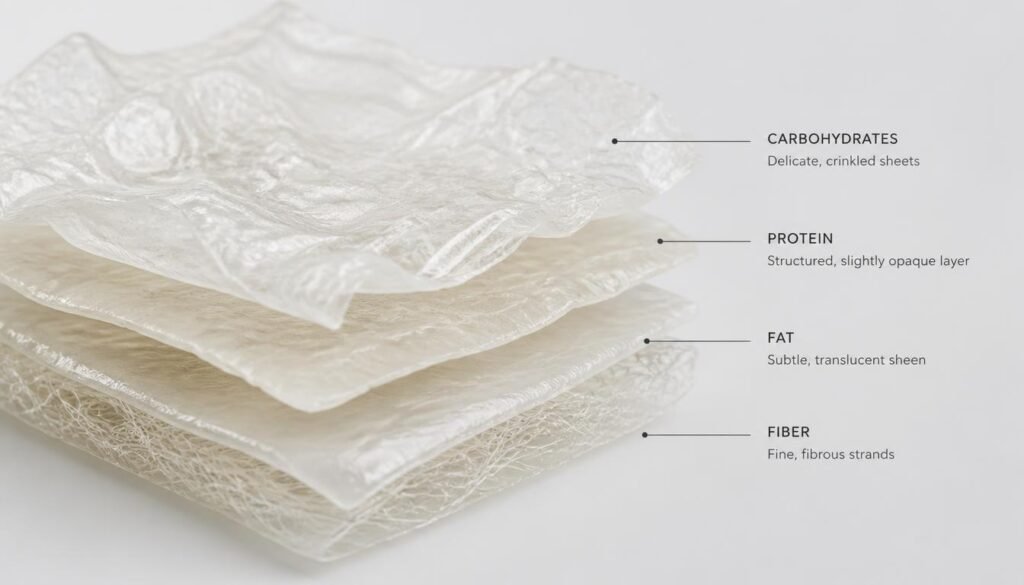
The main macronutrient in rice paper is carbohydrate. Rice paper carbohydrates come primarily from rice flour and starches used to form the thin sheet. For someone following a lower-carbohydrate diet, this matters more than the relatively small calorie number.
A large sheet with around 14.5 grams of carbohydrates can become part of a balanced meal, especially when paired with vegetables and protein. But eating several wrappers at once can make the carbohydrate contribution more noticeable, even though each individual sheet looks very light.
The rice paper protein content is generally modest. One large sheet may contain only about 1 gram, so rice paper shouldn’t be treated as a major protein source. Chicken, shrimp, tofu, pork, crab, eggs, or another lean protein can do that job much better.
Fat is another story. Plain rice paper usually contains very little rice paper fat, often less than half a gram per large sheet. That makes the wrapper itself naturally low in fat, although frying it or adding fatty sauces changes the meal considerably.
Fiber is present, but not in large amounts. A large white rice paper sheet may contain only around 0.42 grams of rice paper fiber. Brown or whole-grain versions may provide more, but again, check the package rather than assuming that darker automatically means high-fiber.
White Rice Paper vs. Brown Rice Paper
White rice paper is the traditional choice in many fresh rolls. It is generally made from refined rice ingredients and has a pale, translucent appearance after soaking. Its flavor is mild, which is exactly why it works so well with herbs, vegetables, noodles, and savory fillings.
Brown rice paper, meanwhile, may include brown rice or whole-grain rice ingredients. Some products are promoted as a source of additional fiber or a more whole-grain alternative. A reference serving of two brown rice paper sheets weighing about 19 grams may provide around 70 calories, though the exact value depends on the product.
Brown rice contains the bran layer, which is removed during the production of many refined rice products. That bran can contribute fiber and micronutrients. Still, not every brown rice wrapper is nutritionally identical, and some contain blends of rice flour and other starches.
The practical takeaway is pretty simple: choose brown rice paper if you enjoy its taste and want the particular nutritional profile offered by that product, but don’t expect a dramatic transformation of your diet from changing the wrapper alone. The filling still gets the starring role.
Is Rice Paper Healthy?
So, is rice paper healthy? In many meals, yes, it can absolutely fit into healthy eating. But “healthy” isn’t a property permanently stamped onto the wrapper. It depends on what surrounds it and how much you eat.
Plain rice paper is relatively low in fat and sugar and can be useful for building meals around vegetables and lean protein. Fresh rice paper rolls can contain lettuce, cucumber, carrots, herbs, shrimp, tofu, chicken, and other nutrient-rich ingredients.
The situation changes when rice paper becomes a vehicle for deep-fried fillings, sweet sauces, processed meats, or large quantities of noodles.
A wrapper containing 49 calories is still 49 calories, but a roll stuffed with fatty sausage and dipped into a sugary sauce is no longer nutritionally comparable to a vegetable-and-shrimp roll.
So rather than asking whether rice paper is “good” or “bad,” a more useful question is: What am I putting inside it? That question gets you much closer to the real answer.
Rice Paper for Weight Loss and Portion Control
Because many wrappers contain relatively few calories individually, rice paper for weight loss can make sense as part of a calorie-controlled diet.
A fresh roll can feel substantial because it contains a combination of crunchy vegetables, herbs, protein, and a soft wrapper, even though the wrapper itself contributes modest energy.
The trick is satiety. Rice paper doesn’t contain much protein or fiber by itself, and those nutrients can help a meal feel more satisfying. Adding high-fiber vegetables and lean protein is therefore a smarter strategy than simply eating more wrappers.
For example, shrimp, tofu, chicken, lettuce, cabbage, cucumber, carrots, mint, coriander, and other herbs can create a filling roll without requiring a large amount of calorie-dense ingredients.
A peanut-based or sweet dipping sauce, however, can quietly add calories by the spoonful, which is where things sometimes go sideways.
Rice Paper and Blood Sugar
Because rice paper is largely carbohydrate, its effect on blood sugar deserves some attention. The exact rice paper glycemic index can vary, and it isn’t always easy to find reliable product-specific GI testing for individual wrappers.
Rice starch can be digested into glucose, and refined rice products may digest relatively quickly. However, the effect of an entire meal isn’t determined by the wrapper alone.
Protein, fat, fiber, vegetables, portion size, and the other ingredients can influence how quickly carbohydrates are digested and absorbed.
Someone concerned about blood sugar spikes, diabetes, or insulin resistance may therefore want to pay attention to the total carbohydrate load rather than simply labeling
rice paper as high-GI or low-GI. Pairing the wrapper with vegetables, protein, and other slower-digesting foods may create a more balanced meal.
If you have diabetes or a medically prescribed carbohydrate target, your own clinician or dietitian’s advice should take priority over generalized food claims. Nutrition is personal in ways a package label can’t always explain.
Is Rice Paper Gluten Free?
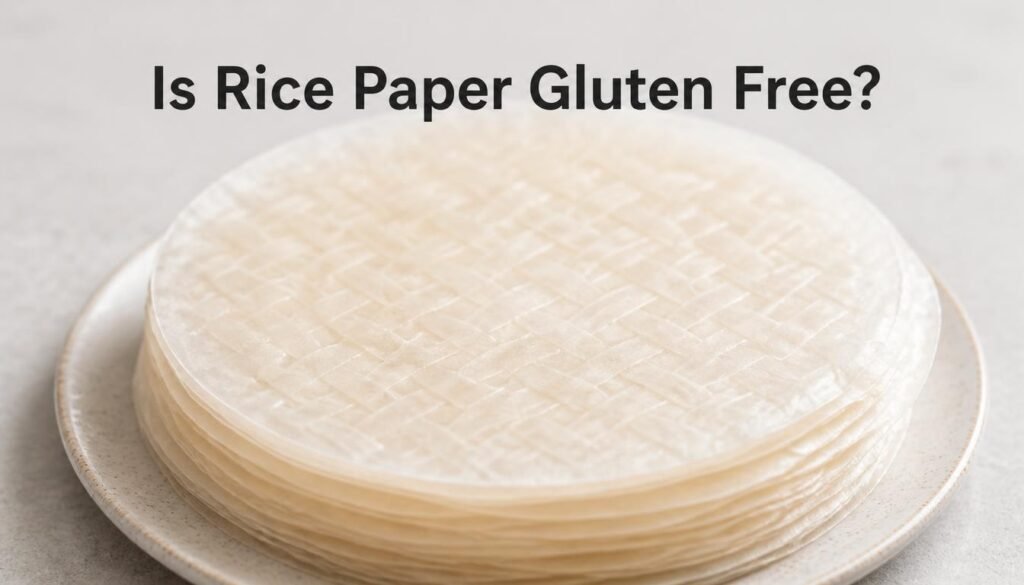
Plain rice paper is commonly suitable for people following a gluten-free diet because rice flour itself does not contain gluten. Traditional wrappers may contain rice flour, water, salt, and sometimes tapioca starch or other gluten-free ingredients.
Still, “rice paper” on the front of a package isn’t enough to guarantee that every product is appropriate for someone with celiac disease. Flavored varieties, seasonings, sauces, and shared manufacturing environments can introduce other considerations.
For strict gluten avoidance, check the ingredient list and look for an appropriate gluten-free certification where needed. A plain wrapper is usually simple, but simple doesn’t mean we should stop reading the label.
Rice Paper Wrappers Compared With Bread and Tortillas
One reason rice paper wrappers have become popular outside Southeast Asian cooking is that they can act as a light alternative to bread or tortillas.
Compared with a typical slice of bread, a rice paper sheet may provide fewer calories depending on the bread and wrapper size. It also tends to contain very little fat. However, bread made from whole grains may offer considerably more fiber and protein.
Compared with tortillas, the answer is equally nuanced. Some tortillas are larger and higher in calories, while others are designed specifically to be low-calorie or high-fiber. Rice paper isn’t automatically nutritionally superior simply because it is thinner.
Think of rice paper as a different tool, not a magic replacement. It can make meals feel lighter and provide a useful bread substitute or tortilla substitute, but the overall nutrition depends on the complete meal.
Rice Paper in Vietnamese and Southeast Asian Cuisine
The story of rice paper is strongly connected with Vietnamese cuisine, where Bánh Tráng is used in a remarkable range of foods. Fresh Gỏi Cuốn, often called Vietnamese summer rolls, are among the best-known examples.
A softened sheet can wrap shrimp, pork, vermicelli, lettuce, herbs, and vegetables into a compact meal. Other preparations use rice paper in fried rolls, snacks, or regional dishes. The ingredient also appears in different forms throughout Southeast Asian and Asian culinary traditions.
You’ll encounter related rice-paper-style preparations in Cambodian cuisine, Thai food, Hmong cooking, and modern Asian fusion. Names and recipes vary, because food traditions don’t politely stay inside borders, thankfully.
Popular preparations and modern variations include:
- Gỏi Cuốn, or fresh Vietnamese rolls with herbs, vegetables, noodles, and protein.
- Nem Nướng Cuốn, featuring grilled pork sausage and fresh ingredients.
- Chả Giò, a Vietnamese fried roll preparation.
- Bò Bía, a Vietnamese-style roll that may combine vegetables and savory fillings.
- Nime Chow, a fresh roll associated with Cambodian cuisine.
- Nam Neung, a regional-style grilled meat roll.
- Tofu summer roll, a popular plant-based variation.
- Lemongrass chicken roll, combining aromatic chicken with vegetables and herbs.
- Soft shell crab roll, a richer seafood variation.
- Bulgogi rice paper wrap, an Asian-fusion interpretation using Korean-style beef.
These dishes also demonstrate why looking only at the wrapper can be misleading. A sheet of rice paper is one ingredient in a much bigger nutritional picture.
Fresh Rice Paper Rolls vs. Fried Rice Paper Rolls
The preparation method can matter nearly as much as the ingredients. Fresh rolls are usually assembled with softened rice paper and eaten without deep frying. They can be relatively light when filled with vegetables and lean protein.
Fried rice paper rolls, on the other hand, absorb oil during cooking. That increases their fat and calorie content, sometimes substantially. A wrapper that started as a modest 49-calorie ingredient can end up in a much richer dish after frying and adding calorie-dense fillings.
This doesn’t make fried rolls forbidden. Food is not a moral exam. It simply means fresh and fried versions shouldn’t be treated as nutritionally identical.
Rice Paper Desserts: The Sweet Side of the Wrapper
Rice paper isn’t limited to savory dishes. Creative cooks have turned it into rice paper desserts, fruit rolls, crispy treats, and fusion-style sweets.
You might see combinations such as Mango Summer Roll, Banana Spring Roll, Strawberry Cream Roll, Coconut Sticky Rice Roll, Fried Apple Rice Paper Roll, or Red Bean Paste Roll. More adventurous versions may include Durian Rice Paper Roll, Pumpkin Spice Roll, or an Avocado Chocolate Roll.
These creations can be fun, but dessert fillings change the nutritional equation quickly. Coconut, chocolate, custard, cream, sugar, and sweetened red bean paste can contribute much more energy than the wrapper itself.
A fruit-heavy roll with fresh mango or strawberries can be a lighter option than one packed with cream and chocolate, though portion size still matters. The rice paper isn’t suddenly high-calorie; the delicious extras are usually where the calories gather.
Rice Paper Micronutrients: Vitamins and Minerals
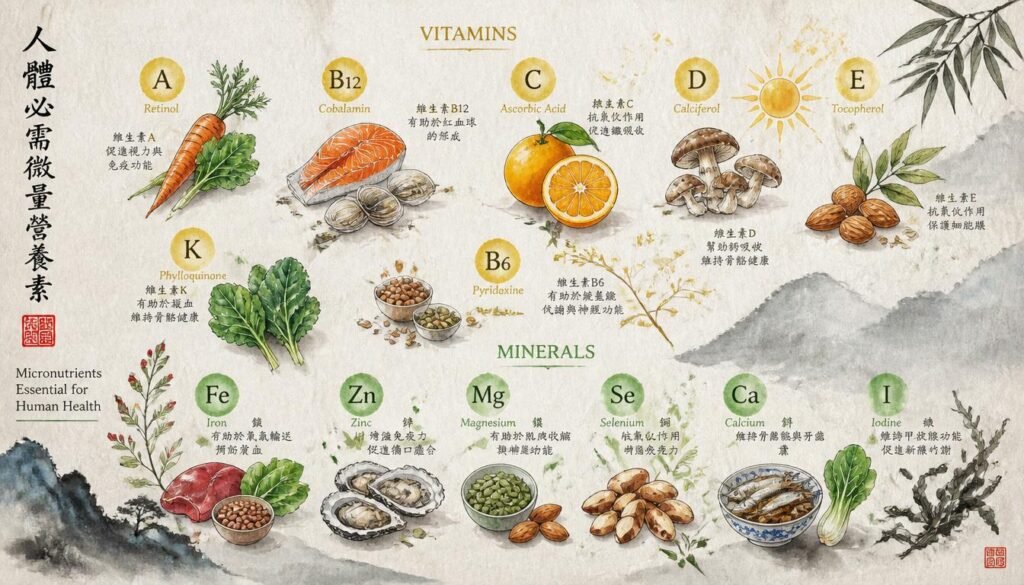
People sometimes assume that because rice paper is low in calories, it must also be rich in vitamins and minerals. Usually, that’s not the case.
Plain refined rice paper generally isn’t a major source of vitamin C, vitamin D, or other vitamins. It may provide small amounts of minerals such as iron, potassium, or sodium, but these quantities vary by brand and formulation.
The wrapper’s leafy greens, colorful vegetables, shrimp, tofu, and herbs can therefore have a much more impressive nutritional profile than the rice paper itself.
The wrapper holds the orchestra together biggest nutritional contribution is generally its carbohydrate content. If you want substantial micronutrients, vegetables, herbs, fruits, seafood, tofu, and other fillings are much more useful places to look.
A roll containing leafy greens, colorful vegetables, shrimp, tofu, and herbs can therefore have a much more impressive nutritional profile than the rice paper itself. The wrapper holds the orchestra together; it isn’t necessarily playing every instrument.
How to Build a More Nutritious Rice Paper Roll
The easiest way to improve rice paper nutrition is to build the meal around ingredients that bring what the wrapper lacks.
Start with vegetables. Lettuce, cabbage, cucumber, carrots, bell peppers, bean sprouts, and fresh herbs can add volume, fiber, color, and texture without making the meal excessively calorie-dense.
Then add a protein source such as shrimp, chicken, tofu, crab, or another lean protein. Protein helps make the meal more satisfying and balances a wrapper that is naturally carbohydrate-heavy.
Vermicelli can be included, but portion size matters because noodles add another significant carbohydrate source. You don’t necessarily need to remove them; just avoid turning every roll into a noodle bundle wearing a tiny rice-paper coat.
For sauces, use enough to make the roll enjoyable rather than drowning it. Peanut sauce, hoisin-based sauce, sweet chili sauce, and other dips can contain concentrated calories, sugar, fat, or sodium.
Freuenly Asked Questions
How many calories are in one rice paper sheet?
A small sheet may contain around 16 calories, a medium sheet around 49 calories, and a large sheet around 66 calories, based on the reference weights of approximately 5 g, 15 g, and 20 g respectively. Actual values vary by brand and size.
Is rice paper good for weight loss?
It can fit comfortably into a weight-loss diet because individual sheets are relatively low in calories. The bigger issue is what you fill them with and how much sauce you use.
Does rice paper contain protein?
Yes, but not much. A large sheet may contain roughly 1 gram of protein, so foods such as shrimp, chicken, tofu, pork, or other protein-rich fillings are more important for meeting protein needs.
Is brown rice paper healthier than white rice paper?
Brown rice paper may provide a different nutritional profile and potentially more fiber, depending on the product. But the actual ingredient list and nutrition label matter more than color alone.
Are rice paper wrappers gluten free?
Many plain rice paper wrappers are gluten-free because they are made from rice flour and starches. Always check the package if gluten avoidance is medically important.
Does rice paper cause blood sugar spikes?
Because it is primarily carbohydrate, rice paper can contribute to a rise in blood glucose. The size of the portion and the other foods eaten with it influence the overall response.
Is rice paper healthier than bread?
Not automatically. Rice paper may be lower in calories and fat than some breads, while whole-grain bread can provide considerably more fiber and protein. The better choice depends on the product and your nutritional goals.
How many calories are in one sheet of rice paper?
A small sheet has about 16 calories, while a medium sheet has around 49 calories and a large sheet about 66 calories.
Is rice paper good for weight loss?
Yes, rice paper can fit well into a weight-loss diet because it is relatively low in calories, especially when filled with vegetables and lean protein.
Is rice paper gluten free?
Most traditional rice paper wrappers are gluten free because they are made mainly from rice flour and water, though ingredients should always be checked on the package.
Does rice paper contain many carbohydrates?
Yes, rice paper is primarily carbohydrate-based. A large sheet may contain around 14.5 grams of carbohydrates, depending on the brand and size.
Is brown rice paper healthier than white rice paper?
Brown rice paper may provide more fiber and nutrients than some white varieties, but the exact nutritional difference depends on the ingredients and product formulation.
read more: https://menupricesaustralia.com/diet-dr-pepper-2/
The Bottom Line on Rice Paper Calories and Nutrition
Rice paper calories and nutrition are pleasantly simple once you stop judging the wrapper by its almost weightless appearance.
A small sheet may contain around 16 calories, a medium sheet around 49, and a large sheet around 66. Most of those calories come from carbohydrates, while fat and sugar remain very low in a plain wrapper.
The real nutritional opportunity is what you wrap inside it. Vegetables can bring fiber and micronutrients. Lean protein can improve satiety and protein intake.
Herbs and fresh ingredients can bring flavor without needing huge amounts of sauce. A fried wrapper, rich filling, or sugary dip, meanwhile, can change the meal quite dramatically.
Whether you’re making Vietnamese Gỏi Cuốn, experimenting with tofu summer rolls, preparing a fresh chicken wrap, or trying a fruit-filled dessert, rice paper can be a flexible part of healthy eating. It is not a miracle food, and it isn’t something that needs to be feared either.
The smartest approach is wonderfully ordinary: check the label, understand your sheet size, watch your portion, and build the rest of the meal thoughtfully. A translucent wrapper may look like almost nothing, but paired with the right ingredients, it can hold quite a satisfying little meal together.
If you’d like, I can also turn this into a more SEO-focused 2,000–2,500 word version with a meta title, meta description, FAQ schema-ready questions, and a keyword-rich H2/H3 structure.


