

Hash Brown
There are foods that arrive on the table with a little ceremony, and then there are foods that simply appear in a paper bag at 8:47 in the morning and somehow become the best part of the whole breakfast.
A Hash Brown belongs firmly in the second group, and thats part of its charm. It is small, golden, crisp around the edges, soft in the middle, and wonderfully uncomplicated.
For many people, a visit to McDonald’s in the morning has its own tiny rhythm: coffee first, breakfast next, maybe a chat in the car, and almost always somebody reaching across for that crunchy potato square.
In Australia, McDonald’s Australia is commonly known as “Macca’s,” and its breakfast menu has become familiar to generations of customers.
The McDonald’s Hash Brown is one of those menu items that does not need a dramatic introduction; the crackle when you bite into it does most of the talking.
Still, there is more to this little breakfast side than its crispy personality, and thats where things get interesting.
Why the Hash Brown Has Such a Loyal Breakfast Following
A good hash brown is basically a small study in contrast: crunchy outside, tender inside, salty enough to wake up your sleepy taste buds, but not so complicated that you need a culinary dictionary to understand it.
The appeal is almost childishly simple, in the nicest way. Potatoes are turned into a compact, fried breakfast food that can be eaten beside a larger meal or enjoyed by itself when you’re in a hurry.
The McDonald’s Hash Browns sold in Australia are designed as a convenient breakfast accompaniment, which explains why they work so neatly beside a McMuffin, coffee or other morning item.
Official McDonald’s Australia nutrition material lists a single serving at around 143 calories, rather than the often-repeated “140 kcal” figure found on older or third-party pages.
Nutrition information can change with product formulations and menu revisions, so the current Australian information is the better place to check, honestly.
- The outside is crispy, giving that familiar first crunch that people weirdly get excited about.
- The inside stays softer and potato-like, so it isn’t just a shell of fried starch.
- The flavour is fairly restrained, with potato, salt and pepper notes doing most of the work.
- It is small enough to fit naturally beside a larger breakfast food, without becoming the entire meal.
- It is quick to eat, which makes it a handy choice during a rushed morning.
- The texture gives it a satisfying contrast with softer foods such as eggs or muffins.
- It is familiar, inexpensive-looking comfort food, and sometimes thats exactly what breakfast needs.
Hash Brown Ingredients: What Is Actually Inside?
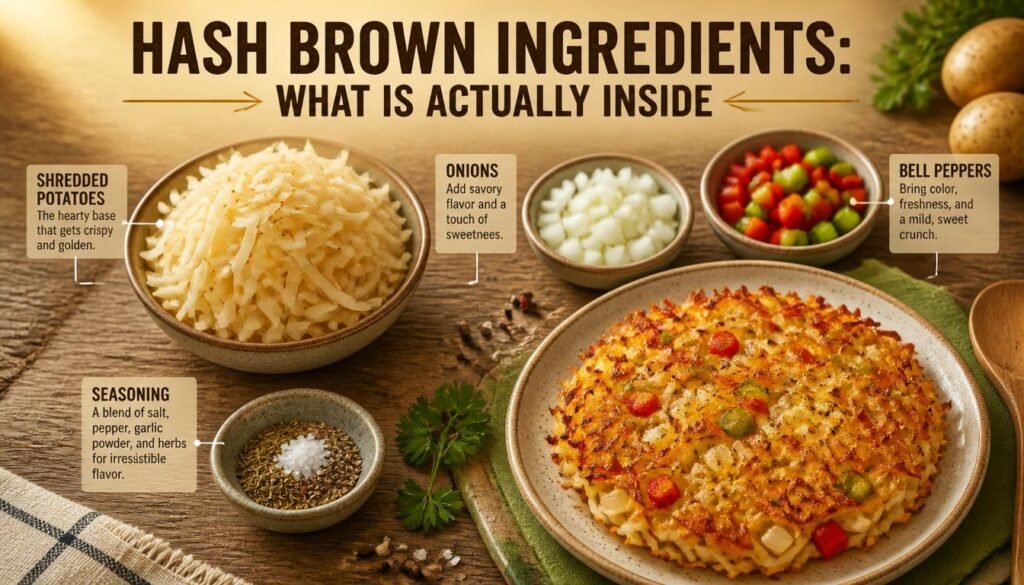
When people search for McDonald’s Hash Brown ingredients, they often expect a giant laboratory-looking paragraph with seventeen mysterious substances hiding behind the potato.
The Australian ingredient information is actually more understandable than that. McDonald’s Australia lists potato, vegetable oil, salt, dextrose from maize, dehydrated potato
and natural flavour from black pepper extracts in its published ingredient information, with the exact formulation presented in its current menu documentation.
The important thing is that the potato hash brown is not simply a whole potato sliced thinly and dropped into oil.
Dehydrated potato is part of the formulation, helping create the texture and structure that lets the product hold its familiar shape.
Maize flour is often mentioned on older or secondary ingredient pages, but the current Australian material uses more specific wording around dextrose from maize and related
formulation ingredients, so copying an old ingredient list as if it were today’s list can get a bit messy.
- Potatoes provide the central ingredient and familiar potato flavour.
- Dehydrated potato contributes to the structure and consistency of the finished product.
- Vegetable oils are used for cooking, giving the surface its fried crispness.
- Non-hydrogenated vegetable oils may appear in general discussions of frying oils, but the current Australian documentation specifically refers to a vegetable oil blend.
- Salt supplies the savoury edge that makes potato taste much more potato-y.
- Dextrose from maize is listed in the ingredient information and can contribute to browning and flavour.
- Black pepper extract or natural pepper flavour provides a quiet spicy note, though it doesn’t arrive shouting at you.
- A stabiliser or other processing aid may appear in formulations or older documents, so checking the latest official list is wiser than trusting a random menu blog.
Hash Brown Nutrition: The Numbers Behind the Crunch
The phrase Hash Brown nutrition sounds slightly more serious than the food itself, but the numbers are useful if you’re keeping track of what you’re eating.
McDonald’s Australia’s published nutrition information gives a serving as approximately 600 kJ or 143 calories, with about 9.6 grams of fat, 0.8 grams of saturated fat, 12.4 grams of
carbohydrates, 1.4 grams of protein, 0.1 grams of sugars, and 293 milligrams of sodium in the July 2025 Australian menu documentation.
That means the familiar online claim of Hash Brown calories 140 is close, but not precisely the figure in the more recent Australian document.
Food databases sometimes round numbers, use older formulations, or pull information from different countries, and this is one of those cases where a tiny numerical difference can create a surprisingly large internet argument.
For practical purposes, think of it as roughly 140 calories, but use the official menu if you need the exact current figure.
- Calories: about 143 kcal per Australian serving, according to the published menu data.
- Fat: about 9.6 grams, which makes fat a major contributor to its energy content.
- Saturated fat: around 0.8 grams, a relatively small portion of the total fat.
- Carbohydrates: approximately 12.4 grams, largely reflecting its potato-based composition.
- Dietary fiber: the current cited Australian table does not prominently provide a fiber value, so don’t invent one just to complete a nutrition chart.
- Protein: around 1.4 grams, meaning it is not really a protein-focused breakfast choice.
- Sugars: roughly 0.1 grams, which is tiny, even if the ingredient list includes dextrose.
- Sodium: approximately 293 milligrams, something worth noticing if you’re monitoring sodium across the whole meal.
The Hash Brown macros therefore tell a pretty straightforward story: it is primarily a carbohydrate-and-fat breakfast side, with very little protein.
Thats not automatically a judgement of “good” or “bad.” A single breakfast side doesn’t determine the nutritional quality of an entire diet, and food isn’t a courtroom where every potato needs to defend itself.
How Many Calories Are in a McDonald’s Hash Brown?
If you’re wondering, “How many calories are in a McDonald’s Hash Brown?” the short answer for the Australian menu is about 143 calories per serving in the published 2025 nutrition information.
Older pages may state 140 kcal, while some international McDonald’s markets have different values, so country matters more than people sometimes realise.
For someone building a breakfast around calorie content, the useful question isn’t only the number attached to the potato square.
Look at the whole order, because a hash brown alongside coffee is a very different nutritional picture from a hash brown plus a large breakfast sandwich, sweetened drink and extra sides.
Numbers become much more helpful when they’re viewed together, not when one little rectangle is placed under a nutritional microscope.
Why It Tastes So Crispy, Crunchy and Soft at Once
Texture is probably the secret weapon here. A crispy breakfast works because your mouth gets several sensations in quick succession:
the first crackle, the salty fried surface, then the softer potato centre. It’s a small thing, yes, but breakfast foods don’t need to be philosophical masterpieces to make a morning better.
The cooking process matters hugely. The hash brown is cooked in a McDonald’s vegetable oil blend, according to the Australian ingredient and nutrition documentation.
That cooking environment helps create the browned exterior people recognise immediately. The result is a breakfast side that can be crunchy without being completely hard, and soft without becoming soggy, assuming you get it reasonably fresh of course.
McDonald’s Breakfast and the Art of the Side Dish
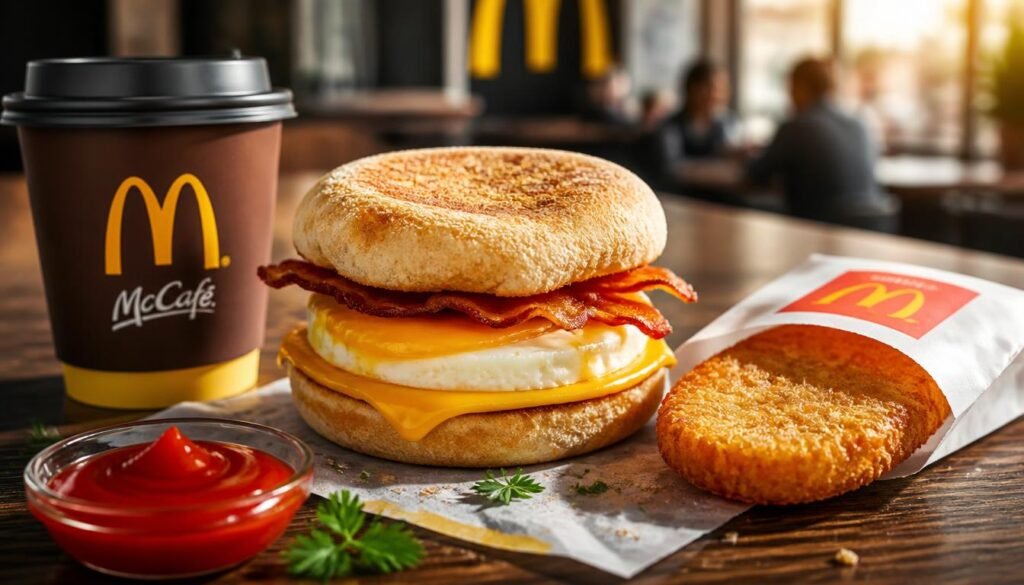
There is something quietly clever about the role of a breakfast side. A main item might carry eggs, cheese, meat or sauce, while the hash brown contributes texture.
It doesn’t compete too aggressively; it just shows up with its little golden jacket and says, “I’ve got crunch covered.”
On the broader McDonald’s breakfast menu, a hash brown can sit alongside familiar choices such as Hotcakes with Butter and Syrup, breakfast sandwiches and coffee.
Comparing it with something like a Big Mac, of course, is more of a playful exercise than a useful nutritional comparison, since the Big Mac belongs to a completely different meal occasion. Breakfast has its own logic, and apparently that logic includes potatoes before 10 a.m.
- Beside eggs, the hash brown adds crispness to an otherwise soft meal.
- With coffee, it becomes a quick and uncomplicated morning combination.
- Alongside hotcakes, it creates a funny sweet-and-savoury contrast that actually works.
- With a breakfast sandwich, it adds a second layer of potato goodness.
- During a hurry, it can be eaten quickly without cutlery or ceremony.
- For a quick meal, it gives a small portion of extra energy without becoming a huge standalone dish.
- As an affordable breakfast side, it can make a simple order feel a little more complete.
Is a McDonald’s Hash Brown Healthy?
“Healthy” is one of those words that gets thrown around online like confetti, and food rarely deserves such a simple label.
A McDonald’s Hash Brown is not a major source of protein, vitamins or fiber, but neither is it some nutritional disaster merely because it is fried.
Its current Australian nutrition profile shows about 143 calories, 9.6 grams of fat and 293 milligrams of sodium per serving.
If your priority is a more filling breakfast, pairing the hash brown with foods that provide protein and other nutrients can make more sense than eating several hash browns alone.
Eggs, for example, can provide protein, while fruit or other nutrient-dense foods can contribute vitamins and fiber. The point isn’t to make breakfast “perfect,” because honestly perfect breakfast sounds exhausting.
McDonald’s Hash Brown Allergens: A Detail Worth Taking Seriously
Allergen information deserves a more careful tone than the usual menu chatter. McDonald’s Australia states that its kitchens handle many allergenic ingredients and that it cannot guarantee food items are free from allergen cross-contact.
Its current Australian allergen documentation specifically warns that hash browns may be cooked using the same equipment as products containing gluten, wheat, milk and soy.
This is important because an ingredient list and an allergen statement are not exactly the same thing.
Someone searching for McDonald’s Hash Brown allergens shouldn’t assume that an allergen absent from the core recipe automatically means zero risk.
The official documentation is the safer reference, particularly for people with serious allergies, and restaurant practices can change over time.
- Eggs: don’t assume an allergen-free environment simply because egg isn’t listed as a core hash brown ingredient.
- Milk: cross-contact information matters, particularly for people with severe milk allergies.
- Wheat and gluten: cooking equipment and restaurant handling can create cross-contact concerns.
- Soy: the official Australian documentation identifies potential shared-equipment exposure.
- Peanuts and tree nuts: don’t infer safety solely from the potato ingredient list.
- Fish and shellfish: restaurant kitchens may handle these ingredients elsewhere.
- Sesame and other allergens: broader kitchen handling can matter even where the recipe itself doesn’t contain them.
- Allergen information: always check the latest official McDonald’s Australia documentation before ordering if an allergy could cause a serious reaction.
For medically significant allergies, the most useful rule is boring but very important: don’t rely on an old blog, social-media post, or somebody’s memory of what was in a hash brown three years ago.
Check the current information and speak with restaurant staff when needed, because formulations and preparation practices can change.
McDonald’s Menu Australia: Why Country-Specific Information Matters
One of the strangest things about fast-food nutrition online is how confidently people mix countries together.
A McDonald’s item can have a different recipe, serving size, calorie count, cooking process or allergen declaration depending on the market.
So a search for McDonalds Menu Australia should ideally lead to Australian information rather than a United States nutrition page copied and pasted into an Australian article.
The same principle applies to McDonald’s Australia ingredient information. The company’s Australian documentation is the most sensible reference for Australian customers, especially when checking current nutrition and allergen details.
Its published documents also note that information is correct at the time of publication, which is a polite reminder that menus are living things, not ancient tablets carved into a mountain.
What Makes a Good Hash Brown Feel So Satisfying?
It isn’t only taste. There is timing involved, too. A fresh hash brown has a particular sound when it breaks, and that sound somehow tells your brain that breakfast is happening properly.
If you’ve ever eaten one in a parked car while the morning is still grey outside, you know the feeling is oddly specific.
There is also the comfort of predictability. You know what you’re getting: potato, crunch, salt, warmth.
In a world where emails multiply before breakfast and phones buzz like they have personal grudges, a tiny piece of food that behaves exactly as expected can feel almost luxurious.
How to Choose It as Part of a Breakfast
If you enjoy a hash brown, you don’t need to turn the decision into a moral debate. Instead, think about what the rest of the meal contributes.
If the hash brown is your favourite part, keep it as the crunchy side and build around it with something that gives you nutrients it doesn’t provide much of, particularly protein or fiber.
A simple approach is to consider the whole plate or whole paper bag, because this is fast food after all. If you’re after a quick breakfast, the hash brown can fit nicely into that routine.
If you’re especially focused on calories, remember the approximate 143 kcal figure and account for drinks, sauces and main items too. Little additions have a sneaky way of becoming the meal.
A Few Hash Brown Myths Worth Leaving Behind
The first myth is that every online nutrition number is interchangeable. It isn’t. The Australian figures have changed across published menu documents, and current material is more useful than an old screenshot.
The second myth is that “potato” automatically means nutritionally ideal. Potatoes can certainly be part of a balanced diet, but preparation changes the nutritional picture, and frying adds considerable fat.
Another misconception is that the word “dextrose” somehow turns the food into a dessert. Dextrose is a form of glucose used in food formulation, and the current Australian nutrition
table lists only around 0.1 grams of sugars per serving for the hash brown. Again, context beats scary-sounding ingredient lists every time.
Where macmenusau.com Fits Into the Picture
Websites such as macmenusau.com can be useful when people are trying to browse menu information in a convenient format, particularly when they want to compare items quickly.
Still, third-party menu sites should be treated as a convenience layer rather than the final authority for changing ingredient, nutrition or allergen details.
For questions involving Hash Brown nutritional information, current ingredients, calories or allergen precautions, the official McDonald’s Australia documentation should take priority.
Thats especially true when health or allergy decisions are involved, because “close enough” is not a particularly good standard for food safety.
Frequnetly Asked Questions
maccas hash brown
Maccas Hash Brown is a crispy and golden breakfast side made mainly with potatoes. It is a popular choice for a quick and tasty breakfast.
mcdonalds hash brown price
The McDonald’s Hash Brown price can vary depending on the location and current menu pricing. Check the latest McDonald’s Australia menu for the current price.
mcdonald’s hash brown ingredients australia
McDonald’s Hash Brown ingredients in Australia include potatoes, vegetable oils, salt, maize flour, dehydrated potato, dextrose, stabiliser, and black pepper extract.
hash browns mcdonald’s price
The price of McDonald’s Hash Browns may differ between restaurants and locations. It is best to check the local McDonald’s menu for the most up-to-date price.
Read this Blog: https://menupricesaustralia.com/kfc-chicken-pot-pie-price-in-2026/
Final Thoughts: Small Potato, Surprisingly Big Personality
The Hash Brown has an unusual kind of food charisma. It isn’t trying to be elegant, sophisticated or revolutionary.
It is a compact potato side with a crispy exterior, a soft centre and a very clear reason for existing: make breakfast a little crunchier. And, to be fair, it does that job rather well.
For Australian customers exploring the McDonald’s breakfast menu, the key facts are fairly simple.
The current published Australian information puts a serving at about 143 calories, with roughly 9.6 grams of fat, 12.4 grams of carbohydrates, 1.4 grams of protein and 293 milligrams of sodium.
The ingredient information centres on potato, vegetable oil, salt, dextrose from maize, dehydrated potato and natural black pepper flavour, while allergen cross-contact remains an important consideration.
So whether you call it a McDonald’s Hash Brown, a breakfast side, a crispy potato square, or simply “that thing I always add to my order,” its appeal is remarkably easy to understand.
Sometimes breakfast doesn’t need a grand plan. Sometimes it just needs a hot coffee, a quiet morning, and one golden little potato rectangle that goes crunch at exactly the right moment.


