

McDonald’s USA Makes Company’s Largest-Ever Investment in Regenerative Agriculture through National Fish and Wildlife Foundation Partnership
There are some investments that arrive with a loud announcement, and then there are the ones that quietly begin changing what happens on the ground.
McDonald’s USA’s latest move belongs, in many ways, to the second kind. It is about cattle, grass, water, soil and wildlife, which sounds almost wonderfully ordinary until you look at the scale of the effort.
On September 15, 2025, McDonald’s USA announced its largest-ever investment in regenerative agriculture,
launching the Grassland Resilience and Conservation Initiative with the National Fish and Wildlife Foundation (NFWF), the U.S. Department of Agriculture’s Natural Resources Conservation Service (NRCS)
and key McDonald’s suppliers. The initiative is designed to invest more than $200 million over seven years and support conservation and regenerative grazing across 4 million acres of U.S. grasslands, potentially reaching up to 38 states. McDonald’s Corporation+1
That number is big, obviously. But the more interesting story is what the money is meant to do: help cattle ranchers improve grazing practices, strengthen soil health, conserve water, restore habitats and make working ranch lands more resilient.
It connects a fast-food supply chain with landscapes where decisions about fences, water systems and grazing schedules can have consequences far beyond a single ranch.
Why McDonald’s USA Is Putting So Much Attention on Regenerative Agriculture
Beef has been part of McDonald’s identity for roughly 70 years, so the company’s relationship with cattle producers is not some brand-new acquaintance.
The beef supply chain reaches deep into rural communities, ranching families and the landscapes where cattle are raised.
That makes agricultural sustainability a rather practical issue for McDonald’s USA, LLC, not just a nice environmental phrase for a corporate report. McDonald’s Corporation
The company says the new investment is intended to support responsible beef sourcing while helping safeguard natural resources. The thinking is fairly straightforward: healthier grasslands can support cattle, wildlife and water resources at the same time, if grazing and land management are handled carefully.
And this is where regenerative agriculture becomes more than a fashionable term. In this initiative, regenerative grazing principles involve voluntary conservation practices that can improve grazing land management, protect grasslands and natural ecosystems, conserve water and provide better habitat for wildlife.
The approach is not about simply putting cattle somewhere greener and hoping for the best. There is actual land management involved, and plenty of it.
McDonald’s says it serves more than 90% of Americans every year, while approximately 13,500 U.S. restaurants form part of its enormous national footprint.
With 95% of those restaurants independently owned and operated, the company’s food system is tied to a huge network of people and communities. McDonald’s Corporation
That scale creates responsibility, but it also creates an unusual opportunity. If a large buyer helps finance conservation practices throughout its beef supply chain, the potential effects can reach places where environmental programs sometimes struggle to find long-term funding. It’s not a magic wand, of course, but it is a pretty serious lever.
The $200 Million Regenerative Agriculture Investment Explained
The headline figure is more than $200 million, committed over the next seven years to support the Grassland Resilience and Conservation Initiative.
The target is roughly 4 million acres of grazing lands across important U.S. grassland regions, including the Great Plains, Rocky Mountain West, Midwest, West Coast and Southeast. NFWF+1
The initiative brings together corporate funding, federal conservation expertise, nonprofit grant-making and ranch-level participation. That combination matters because conservation on private ranch lands often requires more than one organization writing a check and walking away.
NFWF will manage conservation funding and use a competitive grant-making process to select organizations capable of working directly with ranchers.
Those organizations can help producers plan and implement conservation measures, including improved grazing management, habitat restoration, water conservation and infrastructure upgrades. McDonald’s Corporation+1
McDonald’s suppliers are also contributing. Participating companies include Cargill, Golden State Foods, Lopez Foods, OSI and The Coca-Cola Company.
Their participation makes the project broader than a single corporate sustainability program; it becomes a partnership touching different parts of the food and beverage supply chain. McDonald’s Corporation+1
The initiative also includes independent monitoring. Kateri and Carbon Yield are involved in monitoring and quantifying improvements in soil health on behalf of
McDonald’s USA, giving the program a way to track whether conservation practices are producing measurable changes rather than relying entirely on good intentions. McDonald’s Corporation+1
How the Grassland Resilience and Conservation Initiative Works
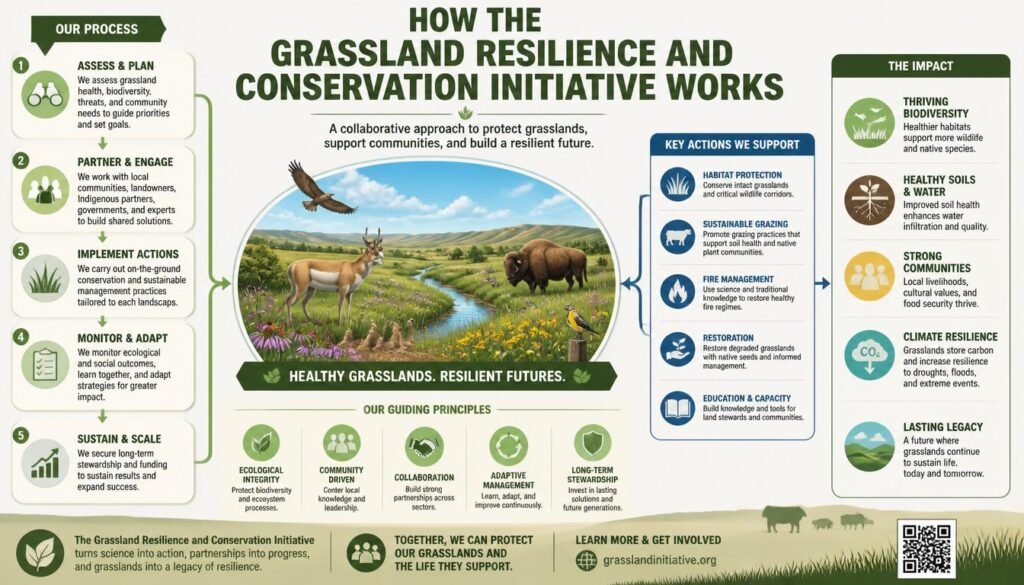
At its heart, the Grassland Resilience and Conservation Initiative is about making conservation workable for ranchers. That distinction is important.
A conservation plan that looks beautiful on paper but cannot fit the economics or daily realities of a cattle operation is unlikely to last very long, and everyone knows that, even if policy language sometimes forgets it.
The initiative is designed around voluntary conservation practices. Participating ranchers can receive technical assistance, financial support and access to resources that help them adopt practices suited to their land and operation.
Those practices may include changes to grazing management, grassland restoration, wildlife-friendly fencing, water systems and other ranch infrastructure. The goal is to improve the condition of working landscapes without separating conservation from the ranching economy.
The concept of regenerative grazing is particularly important here. Well-managed grazing can help maintain productive grasslands, while thoughtful movement of cattle and management of vegetation can support broader soil health and water outcomes.
The exact approach varies by landscape, climate, soil and ranch operation, so there isn’t one universal recipe, which is probably a good thing.
NFWF describes the intended benefits in both ecological and economic terms. Healthier grasslands can hold more water, grow better forage and support wildlife, while conservation practices may also improve productivity and strengthen ranching profitability. McDonald’s Corporation
That intersection is one of the strongest ideas in the program. Ranchers are not being asked to choose between wildlife conservation and running a viable business. Ideally, the same land management decisions can help accomplish both.
Grassland Conservation Is Also Wildlife Conservation
Grasslands can look deceptively simple. A person driving past a broad ranch may see mostly grass, cattle and an enormous sky, but underneath and within that landscape is a complicated web of plants, insects, birds, mammals, water systems and soil organisms.
That is why grassland conservation matters so much. Intact grazing lands can provide wildlife habitat, migration routes and breeding areas while remaining productive agricultural landscapes.
The initiative aims to support wildlife conservation alongside ranching. NFWF works with conservation organizations to identify landscape-scale projects that can provide meaningful benefits to wildlife populations while maintaining the productivity of U.S. ranch lands. NFWF+1
The approach can include habitat restoration, protection of natural ecosystems and conservation of areas that are especially valuable for biodiversity. This is particularly relevant for grassland birds and other species whose habitats are increasingly fragmented.
And there is something rather compelling about the basic idea: a cattle ranch does not necessarily have to be an ecological blank space. Properly managed ranch lands can function as working habitats, where livestock production and biodiversity exist on the same landscape.
Soil Health and Water Conservation Are Central to the Effort
Soil is easy to ignore because it rarely asks for attention. It sits there quietly beneath the grass, doing an astonishing amount of work anyway.
The Grassland Resilience and Conservation Initiative places soil health improvement among its central goals. Better soil conditions can contribute to healthier vegetation, greater productivity and improved water retention, although results naturally depend on local conditions and how practices are implemented.
Independent monitoring by Kateri and Carbon Yield is intended to help quantify soil-health improvements connected with the initiative.
That monitoring component is significant because conservation claims become more useful when they can eventually be measured and compared. McDonald’s Corporation+1
Water conservation is equally important. Ranches depend on reliable water resources for livestock, vegetation and people, while wildlife depends on them too.
Conservation measures can include improvements to water systems, protection of waterways and practices intended to help landscapes retain and use water more effectively.
NFWF’s description of the initiative emphasizes the relationship between healthy grasslands, water and productivity. The basic point is almost wonderfully uncomplicated: land that functions better can be more useful to the people and animals living on it.
What Ranchers Could Gain From the Program
The environmental language surrounding regenerative agriculture can sometimes make ranchers sound like background characters in their own story. This initiative takes a different approach by putting cattle producers near the center of the work.
Participating ranchers may receive incentive payments, technical support and assistance with conservation activities.
These resources can help offset some of the costs associated with changing grazing systems, improving fencing or installing water infrastructure. McDonald’s Corporation+1
That economic dimension is crucial. Conservation has costs, even when the long-term benefits are substantial.
A rancher might understand perfectly well why a different grazing system could improve the land, but understanding the benefit and being able to afford the transition are two very different things.
The program therefore connects conservation funding with ranch profitability and rural economic vitality. NFWF has described voluntary conservation as a potential way to strengthen both grassland productivity and the economic resilience of rural communities. McDonald’s Corporation
It is a more grounded vision of regenerative ranching: not conservation imposed from far away, but conservation designed with the people actually managing the land.
The Role of NFWF and Public-Private Partnership
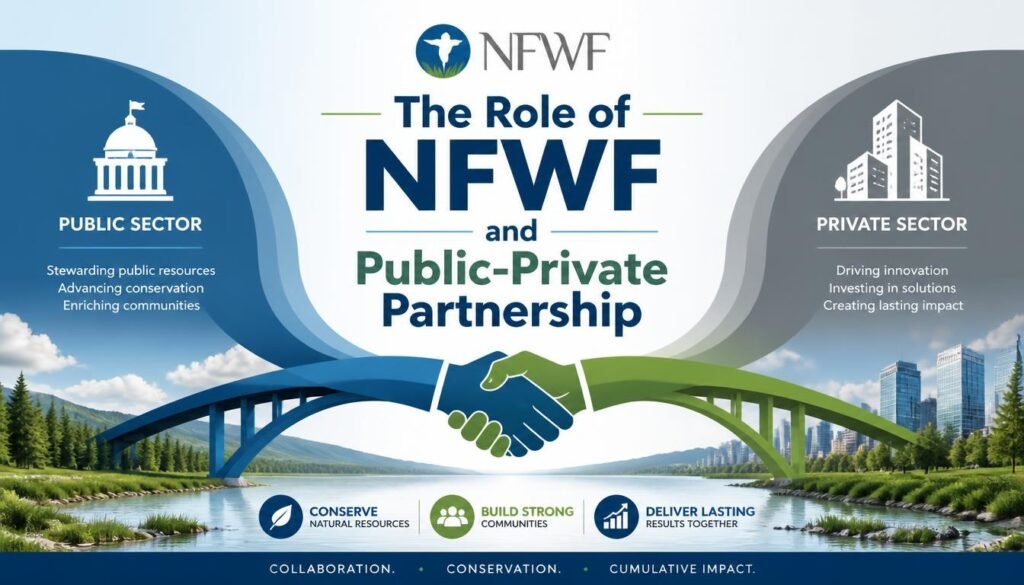
The National Fish and Wildlife Foundation brings a particular kind of experience to the partnership.
Chartered by Congress in 1984, NFWF works with public and private partners to support conservation of fish, wildlife, plants and habitats. McDonald’s describes NFWF as the nation’s largest conservation foundation. McDonald’s Corporation+1
Its role in this initiative is not simply to distribute money. NFWF will use competitive grants to identify organizations that can help deliver conservation outcomes on the ground.
That grant structure creates a bridge between major institutional funding and local expertise. A national program can provide scale, while regional conservation organizations often understand the particular soils, wildlife, ranching practices and water challenges of a place much better.
The model also reflects a growing interest in public-private conservation partnerships. McDonald’s USA and its suppliers bring private investment, the USDA NRCS brings federal conservation expertise, and NFWF brings nonprofit grant-making and conservation coordination. It’s a somewhat unusual team, but that may be exactly why it has potential.
Early Results: From Announcement to Actual Conservation Work
The initiative was announced in 2025, but by 2026 it had moved beyond the launch stage.
In April 2026, NFWF announced its first six grants under the Grassland Resilience and Conservation Initiative.
The awards totaled $32.8 million and were expected to generate nearly $42 million in overall conservation impact when matching contributions were included.
The projects were designed to advance voluntary conservation practices across nearly 2.5 million acres and work with more than 750 private cattle ranch operations across 26 states. NFWF
The initial grantees included the American Bird Conservancy, American Farmland Trust, Mule Deer Foundation, National Audubon Society, Sand County Foundation and the University of Missouri.
Their work covers conservation activities intended to benefit ranchers, wildlife and grassland ecosystems.
Then, in August 2026, NFWF announced nearly $2.4 million in additional grants supporting voluntary conservation easements on working ranches. The six projects covered 31 properties across 11 states and were expected to help permanently conserve more than 100,650 acres of grasslands while keeping ranching operations productive. NFWF
These developments are worth watching because they show the difference between an announcement and implementation.
The original $200 million commitment was a headline; grants, ranch plans, conservation easements, water systems and restored habitat are where that headline eventually becomes real.
What This Means for Sustainable Beef and the Food Supply Chain
The conversation around sustainable beef is often complicated because beef production touches land use, animal agriculture, rural economies, food demand and environmental management all at once.
McDonald’s USA’s approach is focused partly on the resilience of its U.S. beef supply chain. The company expects the initiative to support supply chain resilience through healthier ranch lands and economic benefits for participating producers. NFWF
That matters because a resilient food system is not just about having enough suppliers on a spreadsheet. It also depends on productive land, functioning ecosystems, reliable water resources and ranching businesses capable of continuing through difficult conditions.
In that sense, responsible beef sourcing becomes broader than purchasing standards. It can include supporting the ecological and economic conditions that allow beef production to continue responsibly over time.
There is no single conservation practice that can solve every problem in the beef supply chain, and this program does not claim otherwise.
But supporting regenerative beef production, sustainable grazing and grassland resilience can address several connected challenges at once, which is a sensible place to start.
Why Scale Matters Across U.S. Ranch Lands
Four million acres is difficult to picture. It is the kind of number that becomes abstract very quickly, like counting stars from a city sidewalk.
But landscape-scale conservation is important precisely because wildlife, water and grasslands do not respect property boundaries.
A ranch may be well managed, yet its ecological value can increase when neighboring properties too. Ranchers and conservation groups can compare approaches, understand which practices work in different landscapes and refine strategies over time.
Regenerative ranching should not be treated as and wider landscapes are also protected and managed thoughtfully.
The initiative aims to work across major grassland regions of the United States and potentially reach up to 38 states. NFWF describes the program as a large-scale effort focused on voluntary conservation and grazing management across American grasslands. NFWF+1
That scale could create opportunities for learning, too. Ranchers and conservation groups can compare approaches, understand which practices work in different landscapes and refine strategies over time.
Regenerative ranching should not be treated as one fixed blueprint; it is more useful as a framework for continuous improvement.
A Partnership Where Food and Conservation Meet
Perhaps the most interesting part of McDonald’s USA’s investment is that it sits directly at the meeting point of food production and environmental stewardship.
The company needs a reliable beef supply. Ranchers need productive land and viable businesses. Wildlife needs functioning habitats.
Grasslands need thoughtful management. Communities need economic activity. Water needs protecting. Soil needs attention, even when nobody is looking at it.
Those interests are not always identical, but they overlap more than people sometimes assume.
Cesar Piña, McDonald’s Senior Vice President and Chief Supply Chain Officer for North America, described the initiative as demonstrating how public and private sectors can work together so that feeding people and stewarding natural resources can coexist. McDonald’s Corporation
That is probably the simplest way to understand the whole effort. It is not about turning every cattle ranch into a nature reserve, nor is it about pretending agricultural production has no environmental impact.
It is about finding practical ways for productive ranching and conservation to occupy the same piece of ground.
What to Watch Over the Next Seven Years
The next phase will be less about announcements and more about results. The real test will be whether conservation funding reaches ranchers effectively,
whether regenerative grazing practices remain economically workable, and whether measurable improvements appear are not repaired on a corporate calendar. The strongest results may in soil, water, habitat and grassland condition.
Monitoring will be especially important. Claims about soil health, water conservation or ecological improvement need evidence, and the involvement of independent monitoring partners gives the initiative a mechanism for quantifying at least some outcomes. McDonald’s Corporation+1
The economic results deserve attention too. If incentive payments and technical support help ranchers adopt conservation practices without undermining profitability, that could make the model more attractive beyond this particular partnership.
And there is the question of durability. Seven years is long enough to accomplish meaningful work, but grasslands are not repaired on a corporate calendar.
The strongest results may be the practices that continue after a grant ends, because ranchers have found them useful, affordable and worth keeping.
The Bigger Picture for Regenerative Agriculture in America
McDonald’s USA’s investment does not represent the entire future of regenerative agriculture in the United States, nor should one initiative be expected to carry that weight.
What it does represent is an increasingly important idea: major food companies can use their purchasing relationships and financial resources to support conservation beyond the walls of their restaurants.
The Grassland Resilience and Conservation Initiative connects regenerative grazing, grassland restoration, wildlife habitat conservation, water conservation, soil monitoring, ranch infrastructure and beef supply chain sustainability in one coordinated effort.
It also recognizes something that can get lost in environmental discussions: working lands are still working lands. Ranchers have livelihoods, families, bills and weather risks.
Conservation programs are more likely to succeed when they acknowledge that reality instead of treating economics as an inconvenient footnote.
NFWF’s early grants in 2026 suggest that the partnership is already moving into that practical stage, with projects supporting cattle ranchers and grassland conservation across multiple regions. NFWF
Frequently asked Questions
What is McDonald’s USA’s regenerative agriculture initiative?
McDonald’s USA’s initiative supports regenerative agriculture, including regenerative grazing, grassland conservation, soil health, water conservation, and wildlife habitat protection.
How much is McDonald’s USA investing in the program?
McDonald’s USA is investing more than $200 million over seven years to support conservation and regenerative grazing across approximately 4 million acres.
What is the role of the National Fish and Wildlife Foundation?
The National Fish and Wildlife Foundation (NFWF) manages conservation funding and awards competitive grants to organizations working with ranchers on grassland and wildlife conservation.
How will cattle ranchers benefit from the initiative?
Ranchers can receive conservation funding, technical assistance, and support for practices such as sustainable grazing, improved water systems, fencing, and other ranch infrastructure.
Why is regenerative grazing important for grasslands?
Regenerative grazing can help improve soil health, conserve water, maintain productive grasslands, protect wildlife habitat, and strengthen the long-term resilience of ranch lands.
Read more: https://menupricesaustralia.com/how-do-i-book-a-birthday-party-at-mcdonalds/
Conclusion: A Different Kind of Investment in the Future
A burger may begin in a restaurant, but its story begins much earlier. Before beef reaches a kitchen, there is a ranch, a herd, grass beneath their feet, water somewhere nearby and a landscape that has its own needs.
McDonald’s USA’s more-than-$200-million commitment recognizes that connection in a very large way.
Through its partnership with the National Fish and Wildlife Foundation, USDA NRCS and participating suppliers, the company is putting substantial resources behind regenerative agriculture, voluntary conservation and the long-term health of U.S. grasslands.
The goal is ambitious: support conservation and grazing management across 4 million acres while helping ranchers, wildlife and rural communities. McDonald’s Corporation+1
The initiative will not make every environmental challenge disappear, and honestly, no investments are not about dramatic transformation overnight.
They are about giving land, people and wildlife a little more room to thrive—and then doing it again, across another responsible conservation program should promise that.
Its value will ultimately be measured in healthier soils, conserved water, protected habitats, stronger ranching operations and landscapes that remain productive for the people and wildlife who depend on them.
As the first grants and conservation projects begin taking shape, the story is moving from corporate commitment to boots-on-the-ground work.
That is where regenerative agriculture becomes real—not in the phrase itself, but in a rancher adjusting a grazing plan, repairing a water system, protecting a stretch of habitat or giving grassland a better chance to recover.
Sometimes the biggest environmental investments are not about dramatic transformation overnight. They are about giving land, people and wildlife a little more room to thrive—and then doing it again, across another ranch, another watershed and another horizon.
That is the promise sitting behind McDonald’s USA’s investment, and it is a pretty meaningful one.
The article is intentionally written as a substantive feature rather than a wishes-style list, because the supplied title and source material concern McDonald’s regenerative-agriculture initiative.
It also incorporates the 2026 grant developments so the piece does not read as though the 2025 announcement were still the latest stage of the program.


