

Double Cheeseburger: Ingredients, Calories, Nutrition, Allergens, and What Makes It So Familiar
There are foods you remember for reasons that have almost nothing to do with fine dining. A Double Cheeseburger can be one of those foods. It might show up after a long drive, during a rushed lunch,
on a late night when nobody wants to cook, or simply because you suddenly want something salty, warm, cheesy and a little bit messy. Somehow, two beef patties between a soft bun can feel like a tiny event.
The McDonald’s Double Cheeseburger is especially recognizable because it does not try to disguise what it is.
You get beef patties, American cheese, pickles, onions, ketchup, mustard, and a regular bun, all stacked into a compact burger that has been sitting
in the cultural memory of fast food for years. It is not trying to be a towering restaurant burger. Its whole personality is more like, “I know what I came here for.”
But there is more to this familiar McDonald’s burger than the quick description on the menu. People often search for Double Cheeseburger calories, the exact Double Cheeseburger ingredients,
its nutrition profile, the difference between it and a McDouble, and whether certain ingredients matter for people with food allergies or particular dietary needs.
So, lets take the burger apart not literally with a screwdriver, thankfully and look at what is actually in it, how the numbers work, what the ingredients mean, and what you should know before ordering one.
What Is a McDonald’s Double Cheeseburger?
The Double Cheeseburger is one of the classic sandwiches on the McDonald’s menu in the U.S. It contains two 100% pure beef patties, two slices of American cheese, pickles, chopped onions, ketchup and mustard on a regular bun.
McDonald’s describes the beef as seasoned with salt and pepper, which is a refreshingly uncomplicated description in a food world that sometimes makes a sandwich sound like a chemistry exam. McDonald’s
The important detail here is the cheese. The burger isn’t simply a McDouble with a different name, even though the two can look like cousins who accidentally wore the same jacket.
The Double Cheeseburger vs McDouble question mostly comes down to that additional cheese slice: the Double Cheeseburger has two slices of American cheese, while the McDouble traditionally has one. McDonald’s
That extra slice changes the eating experience more than you might expect. Cheese adds saltiness, creaminess and a soft richness that sits between the savory beef and the tangy pickles. One slice says “cheeseburger.” Two slices says, well, “we’ve made a decision.”
Double Cheeseburger Ingredients: What Is Actually Inside?
The basic Double Cheeseburger ingredients list is fairly easy to understand at the menu level, although individual ingredient specifications can be much more detailed than the names printed on the front-facing menu.
At the recognizable-food level, the sandwich includes:
- 100% beef patties, seasoned with salt and pepper.
- Pasteurized processed American cheese, which gives the burger its familiar smooth melt.
- Pickle slices, bringing acidity and crunch.
- Chopped onions, adding a mild sharpness and savory bite.
- Ketchup, supplying sweetness and tomato flavor.
- Mustard, contributing a little yellow tang.
- A regular hamburger bun, which holds everything together without becoming the star of the show.
McDonald’s specifically states that the Double Cheeseburger contains two 100% pure all-beef patties and two American cheese slices.
The company also notes that its standard nutrition information is based on standard product formulations and serving sizes, though actual nutrient content can vary somewhat because of preparation, serving-size differences, regional or seasonal factors and changes in formulations. McDonald’s
That last point is worth remembering. Food is not manufactured with a ruler in the kitchen, despite how much we sometimes wish it was. A pickle slice here, a little more ketchup there, and suddenly the numbers have wandered a bit.
The Beef Patties: Small, Simple, and Central
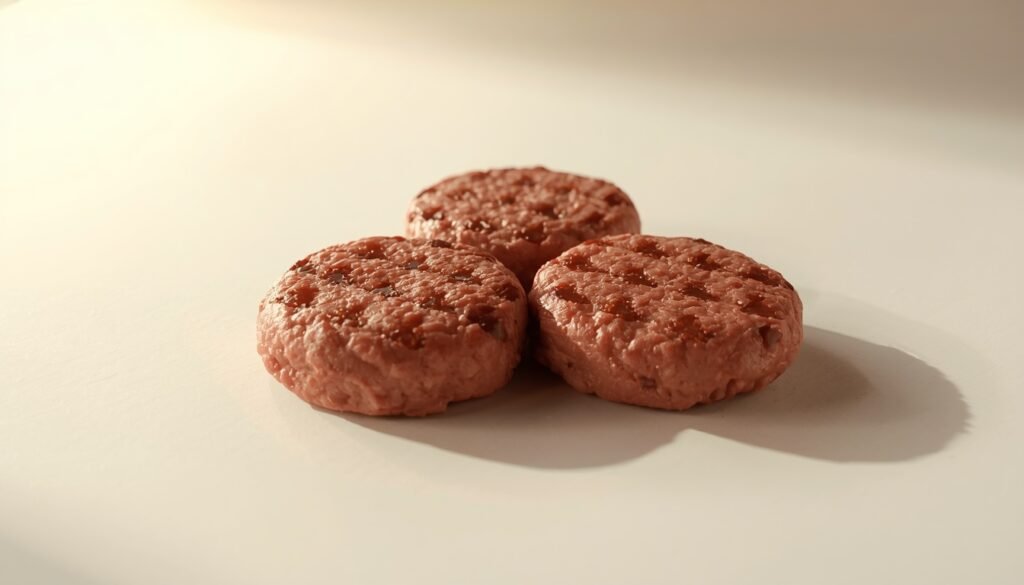
The heart of the burger is obviously the beef patties. McDonald’s describes them as 100% pure all beef and says they are seasoned with a pinch of salt and pepper. McDonald’s
This is part of why the burger tastes different from more heavily seasoned gourmet-style burgers. The beef isn’t buried under a mountain of sauces or exotic toppings.
The seasoning is deliberately straightforward. You get the beef flavor, then cheese, then the sharpness of mustard and pickles doing their little dance around it.
For someone asking how many beef patties are in a Double Cheeseburger, the answer is two. That’s also the simplest explanation for the “double” in the name, though the cheese count matters too.
There is a funny psychological thing about two patties. One patty can feel like a snack. Two patties suddenly feels like lunch has put on a serious shirt.
Why American Cheese Works So Well Here
The cheese on the McDonald’s Double Cheeseburger is pasteurized processed American cheese. It is designed to melt smoothly and consistently, which is precisely what a fast-food cheeseburger needs.
A traditional aged cheddar, for instance, can be delicious but it has a different texture and flavor profile.
American cheese brings softness and meltiness without trying to overpower the beef. It becomes almost part of the sauce once warm, slipping into the tiny spaces between the patties.
And yes, the question does a Double Cheeseburger have two slices of cheese? is important because it separates this sandwich from the McDouble. McDonald’s identifies the extra American cheese slice as the difference between the two menu items. McDonald’s
It is a small difference on paper, but small differences are sometimes the whole point of ordering food.
Pickles, Onions, Ketchup, and Mustard: The Supporting Cast
Take away the toppings and the burger becomes much heavier in character. The pickles provide acidity, which cuts through the fatty richness of beef and cheese. That sour little crunch is doing more work than it gets credit for.
The onions add another savory layer, while ketchup contributes sweetness and tomato flavor. Mustard brings sharpness, and together these condiments stop the burger from becoming one long note of beef-and-cheese.
Interestingly, McDonald’s notes that the pickle contains an artificial preservative, even though the company describes the national Double Cheeseburger as containing no artificial flavors, preservatives or added colors from artificial sources overall. McDonald’s
That distinction matters. Saying a food contains “no artificial preservatives” without context can be misleading if a particular component, such as the pickle, has a preservative.
Ingredient questions deserve the boring little details, because boring little details are often where the useful information lives.
Double Cheeseburger Calories: How Many Are There?
One of the most common searches is how many calories are in a McDonald’s Double Cheeseburger?
According to McDonald’s U.S. product information, the sandwich contains 440 calories. McDonald’s
That figure describes the standard product formulation and serving size. McDonald’s also explains that its nutrition information is based on laboratory testing, published resources
and information from suppliers, with values rounded according to applicable U.S. FDA nutrition-labeling regulations. McDonald’s
The number 440 is useful, but calories aren’t the entire story. A burger’s nutritional profile also includes fat, carbohydrates, protein, sodium and other nutrients.
Your overall meal matters too. A 440-calorie burger accompanied by a large sugary drink and fries is a different nutritional situation than the same burger eaten with water and a lighter side.
And no, one burger does not need to be treated like a moral referendum. Food is food. Context is where the bigger picture lives.
Double Cheeseburger Nutrition in Perspective
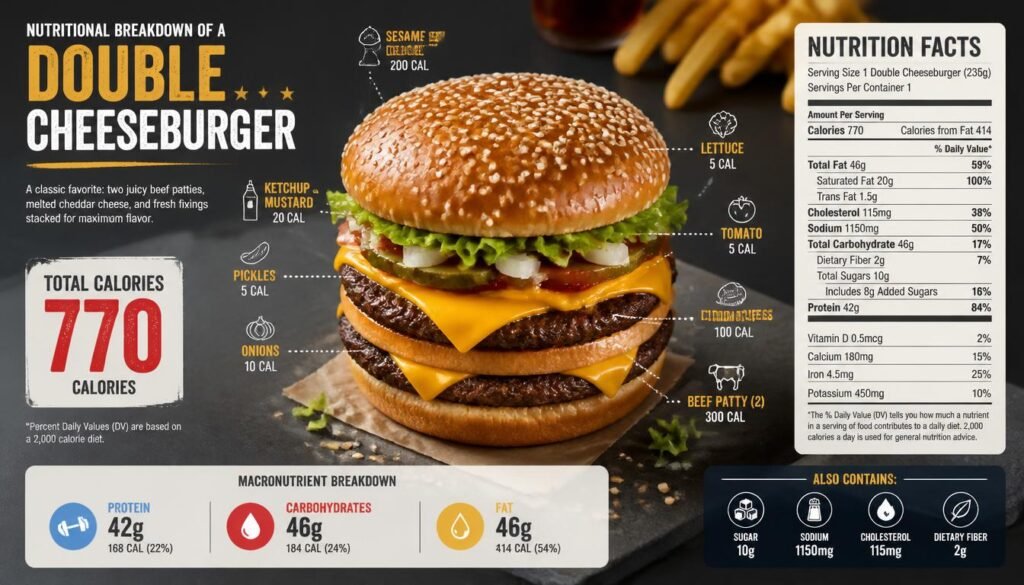
When considering Double Cheeseburger nutrition, it helps to understand what “daily value” actually means.
Nutrition labels commonly use a 2,000 calorie diet as the reference point for Percent Daily Values, but individual calorie needs can be higher or lower depending on the person. McDonald’s makes this same distinction in its nutrition information. McDonald’s
That means a percentage on a nutrition panel is not necessarily a personalized target. It is a standardized reference, useful for comparison but not a perfect description of what your body requires.
The serving size also matters. People sometimes read nutrition numbers without noticing whether they refer to the whole sandwich, a side, a drink or another portion.
The easiest way to avoid confusion is to check the product’s current nutrition page or McDonald’s nutrition calculator before ordering, especially if you are tracking a particular nutrient.
Nutrition information can change over time, too. McDonald’s says formulations can change periodically and that regional and seasonal differences may affect nutrient values. McDonald’s
So if you’re making a strict dietary calculation, don’t rely on an old screenshot someone posted on social media three years ago. The internet remembers everything except the thing you actually need.
Double Cheeseburger vs McDouble: What Is the Difference?
The McDouble vs Double Cheeseburger comparison sounds more complicated than it really is.
Both sandwiches use two beef patties, but the Double Cheeseburger has two slices of American cheese, while the McDouble has one. McDonald’s itself describes the extra slice as the defining difference. McDonald’s
That makes the choice pretty personal. If cheese is the whole reason you order a cheeseburger in the first place, the Double Cheeseburger has an obvious advantage. If you want a similar two-patty format with less cheese, the McDouble is the more restrained cousin.
It’s a funny example of fast-food economics and appetite psychology. One extra slice can turn “pretty good” into “yes, that’s the one.”
How Does It Compare With Other McDonald’s Burgers?
The McDonald’s menu includes several larger or differently structured burgers, and calorie counts can vary substantially between them.
For comparison, the figures provided in McDonald’s nutrition information include approximately:
- Double Cheeseburger: 440 calories.
- Big Mac: 580 calories.
- Quarter Pounder with Cheese: 520 calories.
- Double Quarter Pounder with Cheese: 740 calories.
- Quarter Pounder with Cheese Deluxe: 630 calories.
These comparisons are useful because they show that “double” does not automatically mean the highest-calorie burger. The size of the patties, bun, sauces, toppings and cheese all contribute to the final nutrition profile.
The Double Cheeseburger is comparatively compact. It has two patties but doesn’t come with the larger Quarter Pounder construction.
So it occupies an interesting little corner of the McDonald’s sandwiches lineup: more substantial than a single cheeseburger, but not trying to become a monument.
Artificial Flavors, Preservatives, and Colors
Ingredient questions have become much more important for consumers, and rightly so. People want to know whether a familiar food contains artificial flavors, artificial preservatives, artificial colors, or other food additives.
McDonald’s currently states on its U.S. Double Cheeseburger page that the sandwich contains no artificial flavors, preservatives or added colors from artificial sources, with the important qualification that the pickle contains an artificial preservative. McDonald’s
This is a good example of why the full ingredient information is more useful than a single marketing phrase. A food can meet a particular formulation claim while still containing a specific additive in one ingredient.
If you’re investigating does a McDonald’s Double Cheeseburger contain artificial flavors or does McDonald’s Double Cheeseburger contain preservatives,
the safest approach is to consult McDonald’s current ingredient information rather than relying on an old blog or an ingredient list copied somewhere else.
Food formulations aren’t fossils. They can change.
Double Cheeseburger Allergen Information
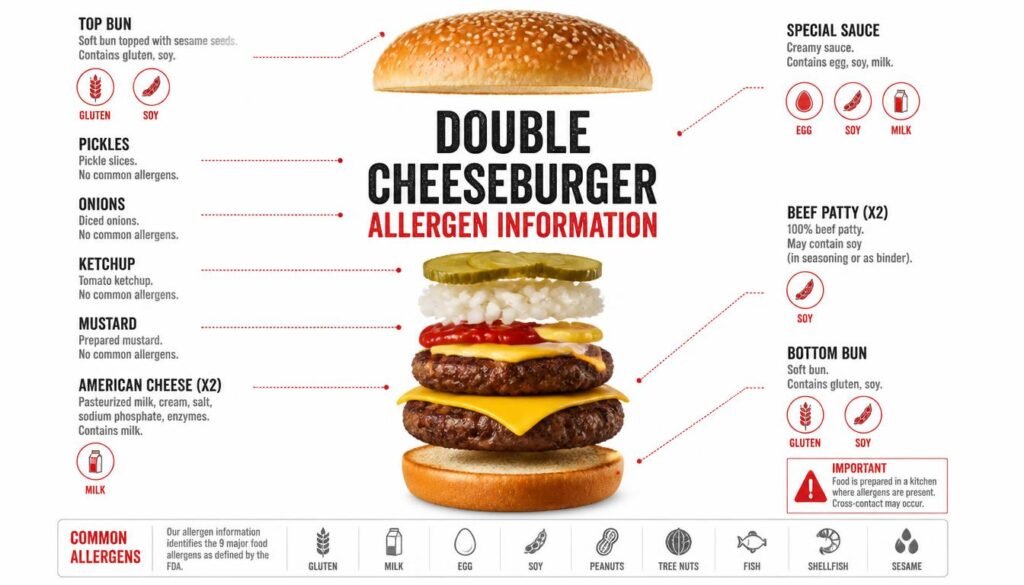
For people with a food allergy, ingredient research isn’t just curiosity. It can be a serious safety issue.
In the U.S., the U.S. Food and Drug Administration (FDA) recognizes nine major food allergens:
milk, eggs, fish, crustacean shellfish, tree nuts, peanuts, wheat, soybeans, and sesame. Sesame became the ninth major allergen under federal law effective January 1, 2023. U.S. Food and Drug Administration+1
For the Double Cheeseburger, dairy, wheat, and soy are particularly relevant areas to investigate based on the ingredients used in the sandwich.
However, someone with a diagnosed allergy should not treat a general internet article as an allergy clearance certificate.
McDonald’s itself recommends that customers with food allergies or special dietary needs consult its ingredient information and speak with their doctor when appropriate. McDonald’s
There is another important issue: cross-contact. Even when an ingredient doesn’t intentionally contain a particular allergen, shared cooking equipment, utensils, preparation areas and normal kitchen operations can matter for highly sensitive individuals.
The FDA also explains that food allergies can produce reactions ranging from relatively mild symptoms to life-threatening reactions, and people with allergies should strictly avoid foods that trigger them. U.S. Food and Drug Administration
So if your question is “Can I safely eat this with my allergy?”, that’s a medical and food-safety question, not merely a menu question. Check the current allergen information and contact the restaurant or manufacturer for clarification when needed.
What About Eggs, Peanuts, Tree Nuts, Fish, Shellfish, and Sesame?
People often search for all nine common allergens when evaluating restaurant food, even when only a few appear directly relevant.
The nine federally recognized major allergens are eggs, milk, fish, crustacean shellfish, tree nuts, peanuts, wheat, soybeans, and sesame. U.S. Food and Drug Administration
This list doesn’t mean every item contains every allergen, obviously. It means these are the allergens that receive specific recognition under U.S.
federal labeling law. The FDA notes that more than 160 foods can cause allergic reactions, so the nine major allergens are not a complete list of every possible food allergy. U.S. Food and Drug Administration
For anyone with severe allergies, the right habit is to verify the McDonald’s food allergy information for the current product and location. Don’t assume that a previous visit, an old menu or a different country will have exactly the same formulation.
Menus travel. Ingredients travel. Policies change. Allergies, sadly, don’t care about any of that.
Dietary Restrictions: Vegetarian, Vegan, Gluten-Free, Halal, and Kosher
Another common search cluster involves whether the Double Cheeseburger fits particular dietary practices.
McDonald’s USA states that it does not certify or claim its U.S. menu items as Halal or Kosher, and it does not promote its U.S. menu items as vegetarian, vegan or gluten-free. McDonald’s
This is especially important because dietary terminology can mean different things to different people. Someone avoiding gluten casually may make a different decision from someone with celiac disease.
Likewise, religious dietary requirements can involve sourcing, preparation and certification details that aren’t captured by simply reading the ingredient list.
If you have strict dietary restrictions, use the current information provided by the restaurant and, where relevant, a qualified medical or religious authority. Don’t let a confident comment on a food forum make the decision for you.
Why People Keep Coming Back to the Double Cheeseburger
There is something almost nostalgic about the Double Cheeseburger. It has the flavor architecture of a food people understand immediately. Beef. Cheese. Pickle. Onion. Ketchup. Mustard. Bun.
No explanation required.
That simplicity may be part of its staying power. The burger doesn’t ask you to learn a new flavor vocabulary before eating it.
The tang of the pickle tells you what it’s doing. The mustard is sharp. The ketchup is sweet. The cheese softens everything. The beef brings the main savory weight.
And because the sandwich is relatively compact, it can fit into ordinary life. It can be lunch between meetings, a road-trip stop, or the thing you order when your brain is too tired to debate twenty-seven menu options.
Sometimes convenience is not glamorous, but it is useful.
A Note About Nutrition Information and Regional Differences
One of the smartest things a consumer can do is treat online nutrition information as a guide rather than a permanent universal law.
McDonald’s says its nutrition information is based on standard formulations and serving sizes, but notes that preparation techniques, product testing, sources of supply, regional differences, seasonal differences and changes in formulations can affect nutrient content. McDonald’s
This matters particularly when people compare a U.S. Double Cheeseburger with a burger sold in another country. The name may be identical while the formulation, bun, cheese, sauce or ingredient sourcing differs.
The same caution applies to calorie-counting apps. Third-party databases can be convenient, but they may contain outdated or incorrect entries. If accuracy matters, check the restaurant’s own current nutritional information first.
How to Make a Better Choice When Ordering
Choosing a burger doesn’t have to become a mathematical crisis.
If you’re simply hungry and want a fast food burger, consider the whole meal rather than obsessing over one number. Look at the burger, side, drink and portion size together.
If you’re watching calories, the 440 calories in the standard Double Cheeseburger can be incorporated into your overall eating pattern rather than viewed in isolation.
If sodium, saturated fat, carbohydrates or another nutrient matters to you, check the complete Double Cheeseburger nutritional information rather than stopping at the calorie count.
And if you have allergies, don’t improvise. Verify ingredients, ask about preparation practices, and make the level of caution match the seriousness of your allergy.
A good food decision is rarely about finding a “perfect” item. More often, it’s about having enough information to choose the item that fits you on that particular day.
Frequently Asked Questions
mcdonald’s double cheeseburger
McDonald’s Double Cheeseburger features two 100% beef patties, two slices of American cheese, pickles, onions, ketchup, and mustard on a regular bun.
mcdonalds double cheeseburger
The McDonald’s Double Cheeseburger is a classic menu item made with two seasoned beef patties and two melty American cheese slices, along with traditional burger toppings.
calories in mcdonald’s double cheeseburger
A McDonald’s Double Cheeseburger contains 440 calories. Its calorie content comes from the beef patties, cheese, bun, and toppings.
how much is a double cheeseburger at mcdonalds
The price of a McDonald’s Double Cheeseburger can vary by location, restaurant, and available offers. Check the McDonald’s app or local menu for the current price.
Read this Blog: https://menupricesaustralia.com/mcdonalds-hash-browns-gluten-free/
Final Thoughts on the Double Cheeseburger
The Double Cheeseburger has survived because it understands something very basic about eating: sometimes people don’t want a culinary speech.
They want two beef patties, melted American cheese, a soft bun, some pickles, onions, ketchup and mustard, and they want it without the sandwich developing an identity crisis.
At the same time, knowing what you’re eating is never a bad thing. The standard McDonald’s U.S. Double Cheeseburger is listed at 440 calories, contains
two beef patties and two American cheese slices, and includes the familiar toppings that give the sandwich its recognizable taste. McDonald’s
For nutrition tracking, use the current official information and remember that calorie needs differ. For allergies, pay attention to the nine major food allergens, possible cross-contact, and the restaurant’s current ingredient disclosures.
The FDA confirms that sesame is now the ninth major allergen under U.S. law, while McDonald’s advises customers with food allergies or special dietary needs to consult its ingredient information. U.S. Food and Drug Administration+1
And perhaps that’s the bigger lesson of this little burger. Familiar food can still deserve curious attention.
A pickle is not just a pickle when you’re investigating preservatives. A slice of cheese isn’t just cheese when you’re checking dairy allergens. And 440 calories is only meaningful when you understand the context around the number.
The Double Cheeseburger remains what it has always been at heart: a straightforward fast-food classic, slightly messy, wonderfully familiar, and occasionally exactly what somebody was craving. There are fancier burgers in the world, certainly. But fancy isn’t always the assignment.
Sometimes the assignment is simply double cheeseburger and honestly, thats a pretty understandable assignment.
I can also adapt this into a more strongly SEO-focused version with a meta title, meta description, FAQ section, featured-snippet answers, and keyword placement while keeping the natural voice.


