

Franchising Overview: How McDonald’s Franchise Ownership Really Works
There is a particular kind of excitement in the thought of owning a business people already know by heart. You don’t have to explain the golden arches at a dinner table, or convince someone that a familiar restaurant can become a serious business.
They already know it. That recognition is one of the strange little superpowers of a strong franchise, and it is a big part of why franchising keeps attracting entrepreneurs who want independence without having to invent an entire business universe from zero.
A McDonald’s franchise, in particular, sits at an interesting crossroads between global scale and local ownership.
The brand provides the operating system, training, marketing infrastructure and recognizable customer experience, while an independent franchisee takes responsibility for running the restaurant as a business.
In the United States, McDonald’s says more than 95% of its restaurants are independently owned and operated, while more than 90% of its U.S. franchise owners have two or more restaurants. McDonald’s+1
That sounds simple until you look closer. It really isn’t just “buy a restaurant and sell burgers.” Franchise ownership means managing people, numbers, customer experience, inventory, reinvestment, compliance and
the thousand tiny decisions that somehow become the personality of a local business. So, this Franchising Overview is less about the shiny promise and more about what the road actually looks like.
Franchising Overview: What Does a Franchise Actually Mean?
At its heart, franchising is a relationship between a franchisor and a franchisee. The franchisor owns the brand, trademarks, systems and intellectual property.
The franchisee receives the right to operate a business using those systems, while following the standards that protect the brand and the customer experience.
Think of it like being handed a very detailed recipe for a restaurant, except the recipe also includes hiring, training, purchasing, technology, marketing and financial controls.
You still have to cook the meal, and if it goes wrong at 7:45 on a Saturday night, the handbook cannot hold the spatula for you. That’s where business management becomes important.
McDonald’s describes its model as giving franchisees the opportunity to be “in business for yourself, but not by yourself,” with support across areas such as operations, training, advertising, marketing, human resources, real estate and purchasing. M McDonald’s
A restaurant franchise therefore offers something that a completely independent restaurant usually cannot: a tested operating framework and an established customer relationship. But it also comes with obligations.
A franchisee does not have unlimited freedom to change the menu, redesign the building or suddenly decide that Tuesday should be “purple food day.” The system matters.
Why the McDonald’s Franchise Opportunity Attracts Entrepreneurs
The appeal of a McDonald’s franchise opportunity begins with familiarity. Customers understand the brand before they walk through the door, which gives the local operator a foundation that a new independent restaurant has to spend years building.
McDonald’s currently describes its U.S. franchising model as having more than 70 years of franchise operations, with 95%+ of restaurants independently owned and operated.
It also highlights hands-on training and community involvement as major parts of its franchise model. McDonald’s
For a prospective franchise owner, that infrastructure can be enormously valuable. You are not starting with a blank page. You are entering a system that has already learned many lessons, some of them probably the expensive kind.
There are other attractions too:
- Brand recognition can make customer acquisition less mysterious than it is for an unknown restaurant.
- Franchise training provides structured preparation before ownership.
- Operational support can help franchisees navigate restaurant management.
- Marketing resources provide access to national and local campaigns.
- Technology systems can support ordering, staffing and business decisions.
- Community presence gives a local business owner an opportunity to build relationships beyond the restaurant.
- Multi-unit ownership can create a pathway for experienced operators to manage several locations.
- A proven operating model gives entrepreneurs a framework instead of asking them to design everything themselves.
Still, none of these things mean profitability is automatic. A famous sign outside the building cannot pay the electricity bill, which is a very unromantic but useful fact about franchise investment.
Understanding McDonald’s Franchise Requirements
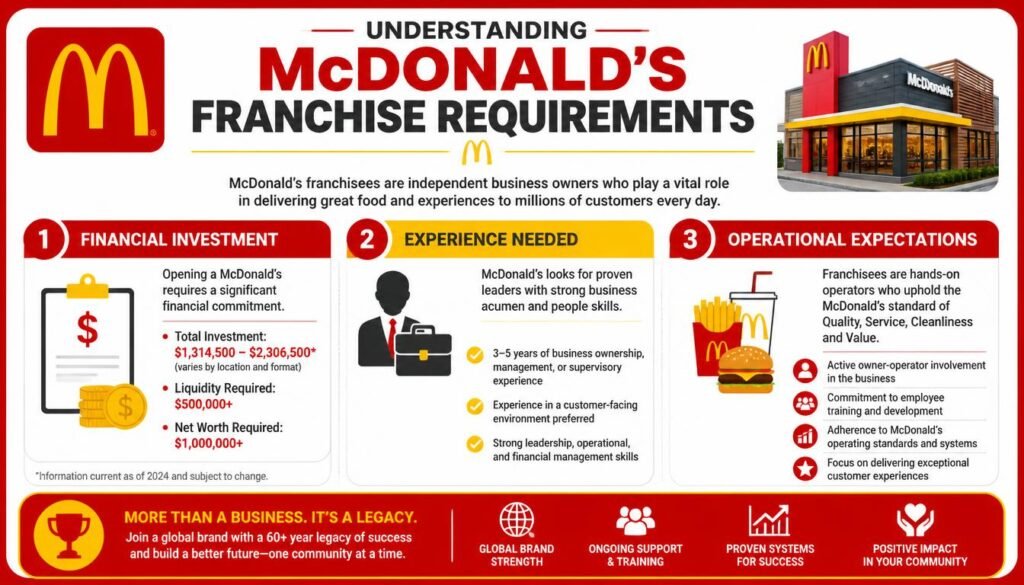
People searching “McDonald’s franchise requirements” often expect a neat checklist, but the real picture is more demanding.
McDonald’s says U.S. candidates typically need at least $750,000 in net, non-borrowed, unencumbered personal funds.
It also recommends at least $100,000 in working capital per restaurant. The $750,000 threshold does not guarantee ownership or a particular restaurant opportunity. McDonald’s
Financial qualification is only one piece of the puzzle.
McDonald’s says candidates must be prepared to commit to the daily operation and management of a restaurant, including overseeing finances, reinvesting in the business and leading a team.
Candidates entering its training program must also be prepared to divest existing business interests and relocate based on restaurant availability. McDonald’s
That last part can surprise people. Franchise availability is not simply a matter of finding an empty building and saying, “That one, please.” The brand decides where development makes sense and which opportunities become available to franchise candidates.
The qualities that matter therefore go beyond money:
- Financial resources sufficient for the purchase and operation.
- A willingness to be deeply involved in restaurant operations.
- Strong leadership and people-management ability.
- A customer-first mindset.
- Comfort with financial analysis and business performance.
- Flexibility regarding relocation.
- Willingness to complete extensive training.
- The ability to make decisions while still operating within a defined system.
- A genuine interest in building teams, not simply owning a sign.
In other words, the ideal franchise candidate is not necessarily the person with the biggest bank account. It is someone who can turn capital, systems and people into a functioning business.
How to Become a McDonald’s Franchisee
The journey to become a McDonald’s franchisee is deliberately structured. According to McDonald’s U.S.
information, candidates begin with an inquiry form and then complete an application. Approved applicants go through interviews before entering the candidate program. McDonald’s
Training follows, and this is not a ceremonial orientation where someone hands you a folder and wishes you luck.
McDonald’s says its training generally lasts 6 to 12 months and combines practical, in-restaurant experience with classroom learning. Candidates may need to work different hours and days depending on restaurant operations. McDonald’s
After successful completion of training, the candidate can discuss available McDonald’s franchise locations.
There may be a delay between completing training and finding a suitable restaurant, because availability depends on actual opportunities in the system. McDonald’s
The broad journey looks like this:
- Submit an initial inquiry.
- Complete the formal franchise application.
- Participate in interviews and candidate evaluation.
- Enter and complete the training program.
- Review an available restaurant franchise opportunity.
- Complete the purchase process.
- Take responsibility for daily business operations.
The interesting bit is that training happens before the restaurant purchase. That tells you something about the model: McDonald’s is not only selling access to a brand; it is trying to develop an operator who can actually run the business.
The Money Behind a Franchise Investment
One of the most searched questions is, naturally, “How much does a McDonald’s franchise cost?” The honest answer is that there is no single universal purchase figure for every restaurant.
The total franchise cost varies according to the restaurant and circumstances. McDonald’s currently states that candidates typically need at least $750,000 in qualifying personal funds, while recommending $100,000 in working capital per restaurant. McDonald’s
It is useful to separate the idea of “money required to qualify” from “total money involved in owning the business.” They are not the same thing.
Potential financial considerations include:
- The purchase price of an existing restaurant.
- The required down payment.
- Operating costs.
- Occupancy costs.
- Equipment and maintenance.
- Payroll and employee-related expenses.
- Inventory and supplies.
- Technology expenses.
- Insurance.
- Taxes and other business obligations.
- Reinvestment into the restaurant.
- Financing terms, where applicable.
- Working capital needed to keep the business healthy.
This is why the question “How much does a McDonald’s franchise make?” cannot responsibly be answered with one attractive number.
McDonald’s itself notes that profitability depends on operating and occupancy costs, financing terms and the franchisee’s ability to operate the business effectively. McDonald’s
A strong franchise profitability analysis therefore needs more than revenue. Revenue is the loud cousin at the family gathering; profit is the quiet person checking the receipts afterward.
Restaurant Operations: The Part Nobody Should Romanticize
Owning a McDonald’s restaurant may sound glamorous when described as entrepreneurship, but the daily reality is operational.
Employees need direction. Equipment needs maintenance. Customer complaints appear at exactly the moment you hoped nobody would complain. Inventory must be managed. Sales patterns have to be watched.
Staffing levels need adjustment. Financial performance has to be understood, not merely glanced at once a month.
The franchise owner becomes a restaurant operator, business manager, employer, community representative and decision-maker all at once.
McDonald’s says franchisees are expected to manage daily operations and financial performance, build and lead teams, deliver customer service and engage with their local communities. McDonald’s
That combination is important because a franchise is still a local business. A customer might recognize the brand globally, but they experience it through one particular restaurant, one particular crew and one particular shift manager. That local experience can make or break the reputation of the business in a neighborhood.
Can a Franchisee Own Multiple Restaurants?
Yes, and multi-unit ownership is a significant part of the McDonald’s franchise model.
McDonald’s currently reports that more than 90% of its U.S. franchise owners have two or more restaurants. McDonald’s
But owning several locations is not simply “one restaurant, multiplied.” Management becomes more complex. A multi-unit franchisee needs systems for leadership, staffing, financial oversight, training, maintenance and performance measurement across locations.
Someone who has successfully managed multiple businesses or departments may therefore be better positioned for multiple restaurant locations than an entrepreneur who has never supervised a team.
The challenge becomes less about personally solving every problem and more about building people who can solve problems well. That is a completely different muscle, and honestly, it takes time to grow.
Location, Site Selection and Property
A common misconception is that someone can purchase a piece of land, place a McDonald’s on it and automatically receive the franchise.
McDonald’s says the site selection process is separate from franchisee selection. The company manages site evaluation, acquires property and constructs the building when
it decides to develop a location. Afterward, it awards the franchise to the most qualified candidate. McDonald’s+1
This means restaurant location is not merely a personal preference. Traffic patterns, customer convenience, demographics, development potential and the broader geographic market all matter.
For someone with commercial property, this distinction is particularly important. Having a potentially excellent property does not mean you automatically receive the right to operate the restaurant there.
The brand has to believe the site works first. Business and real estate, in this respect, are two friends who absolutely must agree before the party starts.
International Franchising and Global Markets
The international franchising side of McDonald’s is even more interesting because the model changes according to local markets.
McDonald’s says nearly 95% of its locations worldwide are owned and operated by local conventional or developmental licensees, reflecting its approach of combining a global brand with independent operators who understand their communities. McDonald’s Corporation
That means global franchising is not simply copying an American restaurant into every country and hoping for the best.
Food preferences, regulations, labor markets, property costs, consumer behavior and cultural expectations vary from one country to another. Local operators bring knowledge that a distant corporate office cannot always manufacture.
For prospective international franchisees, McDonald’s says candidate selection is handled locally by management in the country where the restaurant is located. McDonald’s
So, anyone interested in a McDonald’s franchise outside the United States should research the specific market rather than assuming U.S. franchise requirements apply everywhere. They may not.
What Makes a Strong Franchise Owner?
There is a funny misconception that the best franchise owner is simply an entrepreneur who loves money and has plenty of it.
A successful franchise owner usually needs something broader: patience, discipline, curiosity, people skills and the ability to follow a system without becoming intellectually asleep inside it.
The strongest candidates often demonstrate:
- Leadership under pressure.
- Strong communication.
- Financial discipline.
- Respect for employees.
- A willingness to learn.
- Customer awareness.
- Operational consistency.
- Community involvement.
- Long-term thinking.
- The humility to use established systems instead of reinventing everything.
McDonald’s emphasizes training and support, but support is not substitution. The franchisor can provide a playbook; the franchisee still has to play the match.
The Advantages and Trade-Offs of Franchise Ownership
The appeal of a franchise business is obvious, but every advantage carries a trade-off.
Brand recognition can reduce the challenge of introducing an unknown business, but it also means maintaining strict brand standards.
Training reduces the need to invent processes, but it requires time and commitment. A proven system can reduce uncertainty, but it limits the freedom that comes with running a completely independent restaurant.
The advantages may include:
- Established brand recognition.
- Structured training.
- Ongoing operational support.
- Marketing resources.
- Access to proven systems.
- Potential for multi-unit growth.
- A strong local-business identity.
- Opportunities for professional and personal development.
The trade-offs can include:
- Significant capital requirements.
- Limited operational freedom compared with an independent restaurant.
- Extensive training.
- Responsibility for employees and daily operations.
- Possible relocation.
- Dependence on location and market conditions.
- Continuing business expenses and reinvestment.
- No guarantee of profitability.
This is why franchise qualification should be viewed as both a financial and personal decision. A person may qualify on paper and still discover that restaurant ownership is simply not the life they wanted.
A Practical Way to Evaluate a Franchise Opportunity

Before pursuing any franchise opportunity, step away from the excitement for a moment. Open a spreadsheet. Ask uncomfortable questions. Then ask a few more.
Study the franchise investment required, but also investigate ongoing costs, financing assumptions, working capital and realistic operating scenarios.
Read the relevant disclosure documents carefully and seek independent legal and financial advice where appropriate.
It is also wise to ask yourself:
- Do I actually want to operate a restaurant?
- Can I manage a large team?
- Am I comfortable working within a structured brand system?
- Could I handle a difficult business year without panicking?
- Am I willing to relocate if required?
- Do I have enough liquidity beyond the minimum qualification?
- Am I interested in one restaurant or multiple franchises?
- Can my family and lifestyle accommodate the demands of ownership?
These questions sound ordinary, almost boring. That is exactly why they are useful.
A Note on Franchising Facts and Changing Requirements
Franchise information can change, particularly financial requirements, application procedures, available markets and restaurant opportunities.
McDonald’s current U.S. materials, for example, now state a typical $750,000 minimum in net non-borrowed, unencumbered personal funds, while some older web pages and third-party articles may display different figures. McDonald’s+1
For that reason, prospective franchisees should rely on the franchisor’s current information and applicable legal disclosures rather than an old blog post that has been quietly collecting digital dust since 2019.
The official McDonald’s U.S. franchising pages explain the current process, financial considerations, training and application steps. McDonald’s+1
Frequently asked Questions
mcdonald’s sausage patty
A McDonald’s sausage patty is a seasoned pork sausage used in popular breakfast items like the Sausage McMuffin. It has a savory, slightly peppery flavor and a crisp, browned exterior.
mcdonald’s sausage patty nutrition
McDonald’s sausage patty nutrition varies by serving size and location, but it generally provides protein and fat along with calories and sodium. For the most accurate values, check the current McDonald’s nutrition information for your country.
mcdonalds sausage
McDonald’s sausage is typically made with seasoned pork and is prepared to give breakfast sandwiches their rich, savory taste. The exact ingredients and recipe can vary by market.
mcdonald’s sausage patties
McDonald’s sausage patties are round, seasoned meat portions commonly served in breakfast sandwiches. They are cooked until browned and are usually paired with items such as eggs, cheese, or English muffins.
sausage patty calories
The calories in a sausage patty depend on its size and recipe, but a McDonald’s sausage patty generally contributes a significant portion of the calories in a breakfast sandwich. Check the official nutrition information for the exact calorie count.
Read this Blog: https://menupricesaustralia.com/diet-dr-pepper/
Final Thoughts: Franchising Is Ownership, Not a Shortcut
A McDonald’s franchise opportunity can offer a remarkable combination: a globally recognized brand, a detailed operating system and the chance to become an independent local business owner. But the word “independent” should not be confused with “effortless.”
Real franchise ownership is work. It is people work, numbers work, customer work, early-morning work, problem-solving work and sometimes the sort of work where your coffee goes cold before you remember it was there.
The reward, for the right person, can be more meaningful than simply owning a restaurant. It can mean building a team, developing managers, creating local employment, serving a community and eventually operating several businesses.
McDonald’s itself presents franchise ownership as an opportunity to lead teams and make a meaningful community impact. McDonald’s
The smartest prospective franchisee therefore does not ask only, “Can I afford this?” They ask, “Can I operate this well?”
That second question is the one that matters.
Whether someone is exploring restaurant ownership, researching international franchising, considering a multi-unit franchisee path or simply trying to understand how
a major franchise system works, the lesson is much the same: strong brands can open doors, but capable operators are the ones who keep those doors open.
And perhaps that is the most honest Franchising Overview of all. A franchise gives you a proven road, not a magic carpet.
You still have to drive, watch the turns, maintain the vehicle and occasionally admit you took the wrong exit. But for an entrepreneur with the financial resources, leadership ability,
patience and customer-first mindset to do the work, that road can lead somewhere genuinely worthwhile.
:::


