

What Kind of Beef Does McDonald’s Use in Your Burgers?
There is something oddly fascinating about a McDonald’s burger. You unwrap it, catch that familiar smell, take a bite, and somewhere between the bun and the pickle you may suddenly wonder:
what exactly is inside that little hamburger patty? Is it one particular cut of beef? Is it blended from several parts? And, perhaps the question people ask most, is it actually beef?
For McDonald’s restaurants in the United States, the answer is considerably simpler than some internet rumours make it sound. McDonald’s says its burger patties are made with 100% pure beef, with no fillers, additives, or preservatives added to the beef itself.
The company says it uses trimmings from beef chuck, round, and sirloin, which are then ground and formed into hamburger patties. McDonald’s
That doesn’t mean a patty is made from a single steak-shaped piece of chuck or sirloin, mind you. It means selected portions, including beef trimmings from these cuts, are used as the raw material before becoming ground beef and eventually a burger patty.
So, lets pull the curtain back a little. Not dramatically, not like a detective movie, just enough to understand what is actually going into those familiar McDonald’s burgers.
Is McDonald’s Beef Really 100% Beef?
Yes. According to McDonald’s U.S., every burger patty is made with 100% pure beef. The company specifically states that its patties contain no fillers, additives, or preservatives. McDonald’s+1
That distinction matters because “100% beef” can sound vague when you’re staring at a perfectly uniform patty that came from a fast-food kitchen.
But the basic idea is pretty straightforward: the beef portion of the patty is beef, rather than beef being mixed with bread crumbs, flour, soy protein, or other bulking ingredients.
McDonald’s describes the process as using the trimmings of cuts such as chuck, round, and sirloin, followed by grinding and forming.
In other words, the beef is not magically transformed from a whole steak into a patty at the restaurant. A controlled preparation process happens before the patty reaches the kitchen. McDonald’s
There is a small but important point here. 100% pure beef refers to the beef patty itself, not the entire finished burger.
A McDonald’s burger can also contain a bun, cheese, pickles, onions, ketchup, mustard, sauce, or other ingredients depending on the product.
The patty and the burger are two different things, even though we casually call the whole sandwich a “burger.”
What Cuts of Beef Does McDonald’s Use?
This is where the answer becomes more interesting.
McDonald’s U.S. says it uses trimmings from chuck, round, and sirloin for its hamburger patties. These are all familiar beef cuts, but they have different locations and characteristics on the animal. McDonald’s
Chuck generally comes from the shoulder area. It is well known in traditional cooking because it can contain a useful amount of connective tissue and fat, depending on the particular portion.
Round comes from the rear leg area. It is commonly associated with leaner beef cuts.
Sirloin comes from the area toward the rear of the animal, between the loin and round. It is a familiar steak category and is prized in many forms of beef preparation.
But don’t picture three miniature steaks being tossed together in a bowl. The word “trimmings” is doing some useful work here.
The beef trimmings used for ground beef are portions remaining after larger cuts are prepared. They can be ground together to create a consistent raw material for hamburger patties.
So the important point isn’t that every McDonald’s patty contains a separately identifiable chunk of chuck, round, and sirloin. Rather, McDonald’s identifies these cuts as sources for the beef trimmings used in its patties. McDonald’s
What Are Beef Trimmings, Exactly?
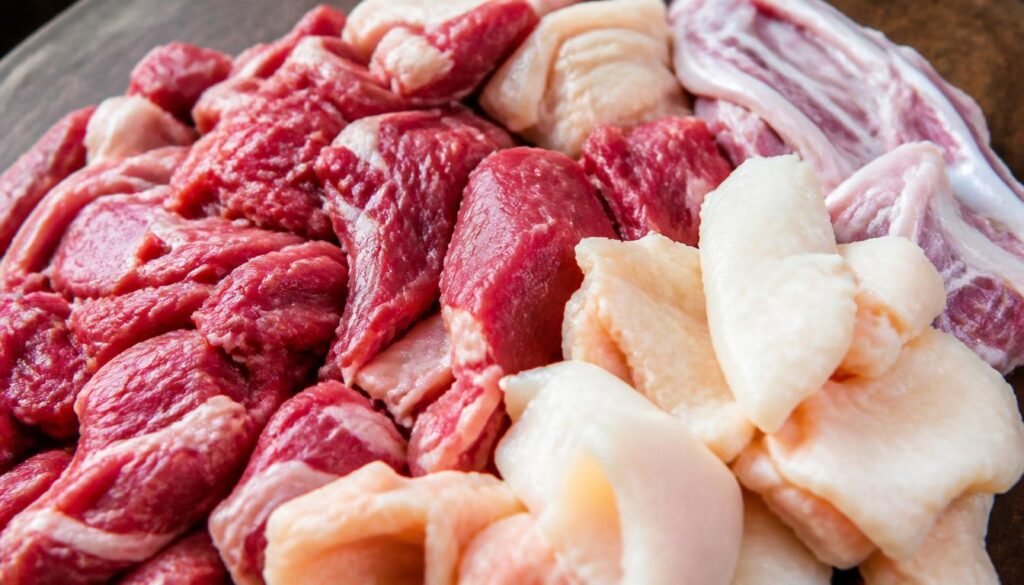
The phrase beef trimmings can sound suspicious if you’ve never worked around meat preparation. It shouldn’t automatically be interpreted as scraps or unwanted mystery meat, though. In professional meat processing, trimming is a normal part of cutting larger pieces of meat into useful portions.
Imagine preparing a large cut of beef for steaks or roasts. You might remove pieces of fat, connective tissue, or irregular sections to produce a particular shape. Those removed portions don’t necessarily become rubbish. They can be useful ingredients for ground beef.
That’s essentially why grinding exists in the first place. It allows suitable portions of beef to be combined into a uniform product rather than requiring every burger patty to come from one perfectly shaped piece.
McDonald’s says its patties use trimmings from chuck, round and sirloin, which are then ground and formed. McDonald’s
So when someone asks, “Which steak does McDonald’s use for its burgers?” the honest answer is a little less glamorous and much more useful: it isn’t simply one steak cut. The company uses beef trimmings associated with several cuts.
How Does McDonald’s Hamburger Meat Become a Patty?
Before a patty arrives at the restaurant, it has to go through a sequence of preparation steps.
The first major step is grinding. Beef suitable for the product is processed into ground beef, producing the texture needed for a hamburger rather than a steak or roast.
Then comes hamburger patty formation. The ground beef is shaped into the familiar flat, round forms that fit into the restaurant’s burger assembly process.
McDonald’s says its 100% beef is ground, formed into patties and then flash frozen. Flash freezing rapidly lowers the temperature, helping preserve the product as it moves through distribution. McDonald’s+1
This is one reason the idea of “fresh versus frozen” needs a little context.
For many standard McDonald’s burgers in the U.S., the beef patty is prepared and then frozen before it reaches the restaurant.
That doesn’t mean the patty contains preservatives simply because it has been frozen. Freezing itself is a preservation method, and McDonald’s describes its patties as being flash frozen after formation. McDonald’s
Are McDonald’s Hamburger Patties Seasoned?
Yes, but the beef itself is kept remarkably simple according to McDonald’s U.S.
The company says its burgers are cooked and prepared with salt and pepper and nothing else, while also stating that there are no fillers, additives, or preservatives in the beef patties. McDonald’s
That is worth separating from the rest of the burger.
If you’re eating a cheeseburger, for example, there are obviously other ingredients involved. Cheese isn’t beef. Pickles aren’t beef. The bun isn’t beef. Ketchup and mustard certainly aren’t beef.
But when the question is specifically about the patty, McDonald’s describes the beef as 100% pure beef, seasoned with salt and pepper. McDonald’s
It’s a surprisingly short ingredient story for something that has been the subject of so many complicated rumours.
Does McDonald’s Add Fillers to Its Beef?
According to McDonald’s U.S., no.
The company explicitly says its burger patties contain no fillers, no additives, and no preservatives. McDonald’s+1
This means the beef isn’t being bulked up with ingredients such as cereal, flour, or soy protein to make the patty larger.
The phrase beef without fillers is therefore an accurate shorthand for what McDonald’s says about its U.S. beef patties.
There is another distinction worth remembering, because food terminology can get muddled quickly. Saying that a beef patty contains no fillers doesn’t mean the entire sandwich has no additives or preservatives. A burger is assembled from multiple components, each with its own ingredient list.
The claim applies specifically to the beef patty.
Are the Patties Made From Whole Cuts or Scraps?
This is probably the point where language causes the most confusion.
McDonald’s says it uses trimmings of cuts including chuck, round and sirloin. McDonald’s
The word “trimmings” does not mean the company is secretly using random leftover pieces that nobody would otherwise eat. In meat processing, trimming is part of producing standardized cuts. Portions removed during cutting can be directed into ground beef, where they become part of a uniform mixture.
Think of it like woodworking, only considerably more appetizing if you’re hungry: the offcuts from producing a particular shape can have another useful purpose.
Once appropriate beef portions are ground, they no longer resemble their original cuts. After forming, they become the familiar hamburger patty.
So the patty isn’t best understood as a tiny slab of sirloin or a compressed chuck steak. It’s ground beef prepared from identified beef cuts and shaped for use as a hamburger.
Does Every McDonald’s Burger Use the Same Beef?
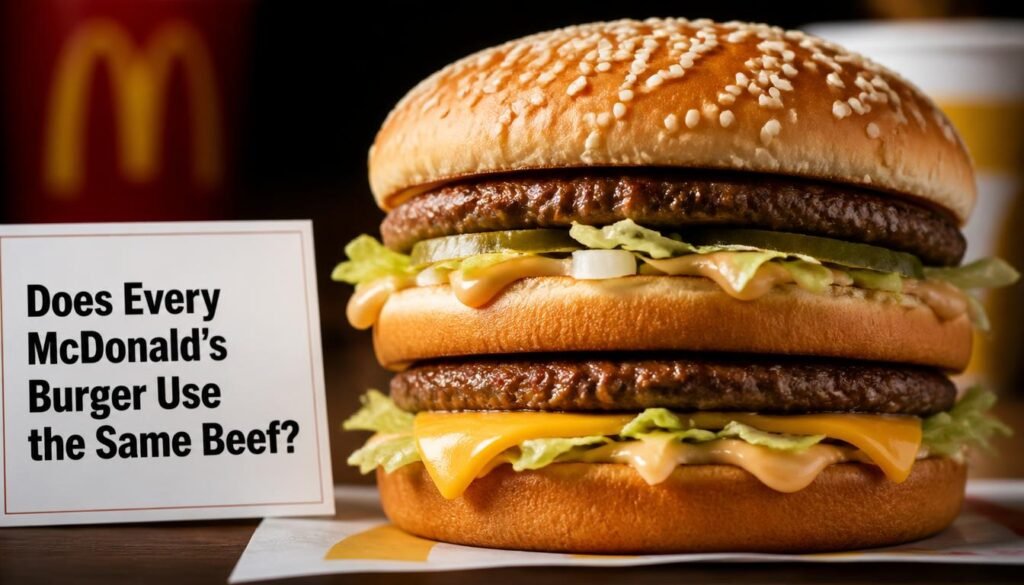
This is where a little caution is helpful.
McDonald’s menus and food preparation can vary by country, and the company’s own U.S. information is specifically about McDonald’s restaurants in the United States. McDonald’s also directs customers to individual country websites for international menu and ingredient information. McDonald’s
Therefore, saying “McDonald’s everywhere uses exactly the same beef” would be too broad.
For the United States, however, McDonald’s identifies chuck, round and sirloin trimmings as sources for its burger patties. McDonald’s
This geographical distinction matters more than it may seem. Beef sourcing, menu products, suppliers, labeling requirements, and preparation methods can differ between markets.
So if you’re asking about a McDonald’s burger in another country, the most reliable answer comes from that country’s McDonald’s ingredient information rather than assuming the U.S. recipe applies worldwide.
What About the Quarter Pounder?
The Quarter Pounder with Cheese is a useful example because its beef preparation differs from some of the other McDonald’s burgers in the U.S.
McDonald’s says the Quarter Pounder with Cheese uses 100% fresh beef, cooked when you order it, at most restaurants in the contiguous United States. McDonald’s
That means “fresh” here refers to the state of the beef before cooking, rather than implying that every McDonald’s beef patty is fresh and never frozen.
McDonald’s says its general 100% beef is ground and formed, then flash frozen, while the Quarter Pounder is made with fresh beef and cooked when ordered. McDonald’s+1
It’s a subtle distinction, but an important one if you’re trying to understand McDonald’s beef rather than simply memorizing a slogan.
What About the Big Mac?
The Big Mac is another familiar example.
McDonald’s describes the Big Mac as containing two 100% pure all-beef patties. McDonald’s
The patty is still only one part of the finished product. A Big Mac also includes its bun, Big Mac sauce, pickles, lettuce, onion and American cheese, among other components. McDonald’s
So when people say “What are McDonald’s burger ingredients?” it’s useful to ask whether they mean the entire sandwich or the beef itself.
For the beef, the answer is quite narrow: 100% pure beef, with McDonald’s stating that the patties contain no fillers, additives or preservatives.
For the whole burger, naturally, the ingredient list becomes much longer.
Is McDonald’s Hamburger Meat Processed?
Technically, almost any meat that has been ground and shaped into a patty has undergone processing.
But “processed” can mean different things in everyday conversation.
A ground beef patty is processed in the literal sense that whole pieces of meat are mechanically ground and then formed. That does not automatically mean that the meat has been blended with a long list of unrelated ingredients.
McDonald’s describes its beef as ground and formed and says that its patties contain no fillers, additives or preservatives. McDonald’s+1
In other words, grinding is part of the preparation process. It isn’t evidence by itself that the patty contains mysterious ingredients.
The distinction is simple but often lost online: mechanically processed meat and heavily formulated meat products are not necessarily the same thing.
Why Use Chuck, Round and Sirloin?
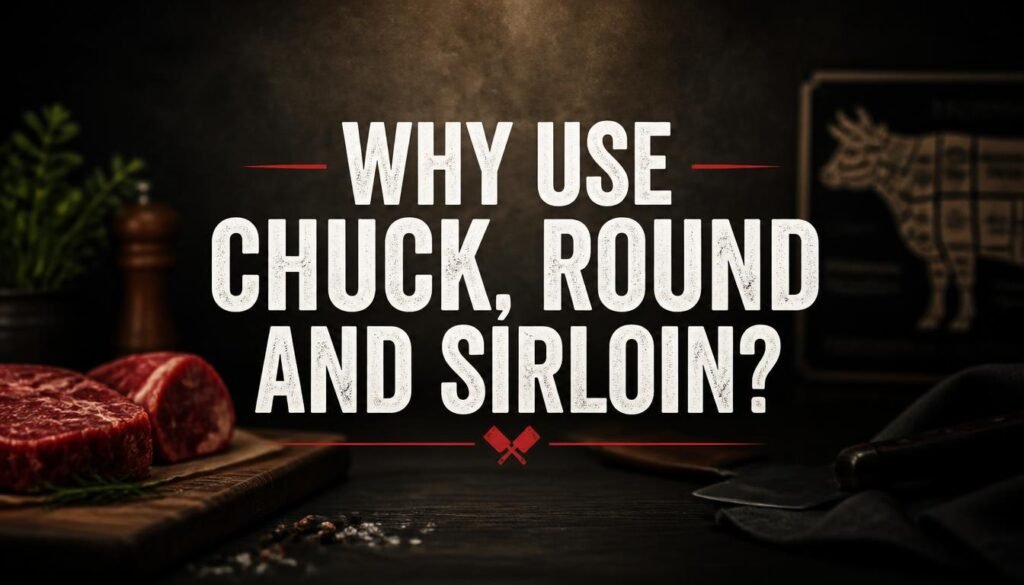
Different cuts bring different characteristics to ground beef.
Chuck beef is commonly used for burgers because portions from the shoulder can contribute useful fat and beefy flavor. Round beef tends to be leaner, while sirloin beef is a familiar higher-value beef category associated with the rear section of the animal.
When these types of beef are used in ground form, the processor can create a consistent hamburger product without requiring every patty to originate from a single cut.
That’s the practical beauty of grinding, really. A steak needs to look like a steak. Ground beef doesn’t. Once the beef is properly ground and blended, it can be formed into consistent patties.
This makes large-scale beef patty formation possible while still starting with recognizable beef cuts.
Does “100% Beef” Mean No Salt or Pepper?
No. This is a little wording trap.
When McDonald’s says its patties are 100% pure beef, it is describing the beef composition. The company separately states that the patties are cooked and prepared with salt and pepper. McDonald’s
So “100% beef” doesn’t mean the finished patty contains literally nothing except untreated raw beef at every stage.
It means the meat component is beef, while the stated seasoning is salt and pepper.
And that makes sense when you think about what happens on the grill. Even a very straightforward beef patty needs seasoning to produce the familiar flavor people associate with a cooked hamburger.
What Happens to the Beef at the Restaurant?
For standard U.S. McDonald’s beef patties that are frozen before delivery, the restaurant receives the formed product and cooks it as part of the burger preparation process.
McDonald’s explains that its 100% beef is ground, formed and flash frozen before distribution. McDonald’s
The restaurant’s job is therefore not to grind a side of beef every time somebody orders a cheeseburger. That would be rather difficult to pull off during the lunch rush, to put it mildly.
Instead, the standardized patties arrive ready for cooking. This helps McDonald’s maintain consistency in size, shape and preparation across a very large restaurant network.
The Quarter Pounder is an exception in the U.S. system because McDonald’s says it uses fresh beef and is cooked when ordered at most restaurants in the contiguous United States.McDonald’s
Does Freezing Mean the Beef Is Lower Quality?
Not necessarily.
Freezing and quality are separate questions.
McDonald’s says its regular 100% beef is flash frozen after being ground and formed into patties. The stated purpose is to quickly freeze the beef and seal in fresh flavor. McDonald’s
Freezing is a widely used food-preservation technique. It does not, by itself, transform beef into an entirely different ingredient.
The more useful question is what the beef is made from and how it is handled. In the U.S., McDonald’s identifies its beef as 100% pure beef and names chuck, round and sirloin trimmings as the source cuts. McDonald’s
So if you have been wondering whether a frozen McDonald’s patty is somehow secretly made from a different substance, the company’s published description doesn’t support that idea.
What Is Actually in a McDonald’s Beef Patty?
Strip away the bun, sauce, cheese and toppings, and the picture becomes quite uncomplicated.
For McDonald’s U.S. beef patties, the company says the product is made from 100% pure beef, using trimmings from chuck, round and sirloin, which are ground and formed into patties. The beef is prepared with salt and pepper, with no fillers, additives or preservatives added to the patty. McDonald’s
That means the central chain looks something like this:
chuck + round + sirloin trimmings → ground beef → hamburger patty formation → cooking → burger
It sounds almost too ordinary, which is perhaps why the subject has attracted so many strange stories over the years.
The actual explanation is much less mysterious.
What McDonald’s Beef Is Not
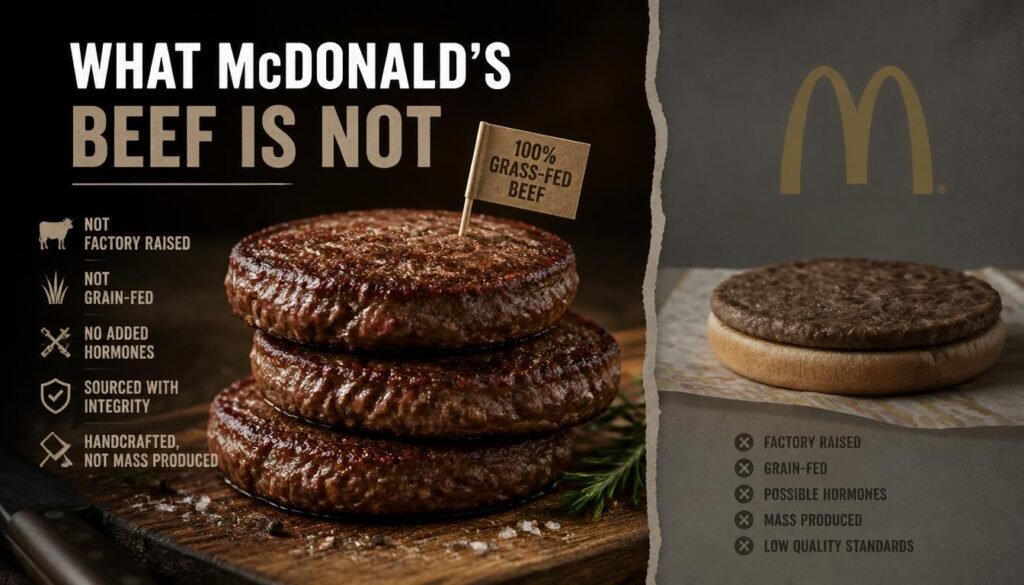
Sometimes the easiest way to understand a food is to remove the myths surrounding it.
According to McDonald’s U.S. information, its burger patties are not made with filler ingredients designed to bulk up the meat. The company specifically says there are no fillers, no additives, and no preservatives in the beef patties. McDonald’s+1
They also aren’t described as being made from one exclusive premium steak cut.
Instead, McDonald’s identifies beef trimmings from chuck, round and sirloin as the raw material used for its hamburger patties.
And they aren’t cooked from raw, freshly ground beef at every restaurant for every order. Standard U.S. patties are generally ground, formed and flash frozen beforehand, while the Quarter Pounder uses fresh beef at most restaurants in the contiguous U.S. McDonald’s
Once you separate those details, the whole thing becomes much easier to understand.
A Simple Answer to the Big Question
So, what kind of beef does McDonald’s use in your burgers?
In the United States, McDonald’s says its burgers are made with 100% pure beef. The company identifies chuck, round and sirloin as cuts from which beef trimmings are used.
Those trimmings are ground, formed into hamburger patties, and prepared with salt and pepper. McDonald’s says there are no fillers, additives or preservatives in the beef patties. McDonald’s
For standard burgers, the patties are ground, formed and flash frozen before reaching restaurants. The Quarter Pounder with Cheese uses 100% fresh beef and is cooked when ordered at most restaurants in the contiguous United States. McDonald’s+1
So the answer isn’t “one secret cut,” and it isn’t a mysterious blend of unidentifiable ingredients either.
It’s ground beef from specified beef cuts, shaped into patties and cooked.
Frequently Asked questions
is mcdonalds meat real
Yes. McDonald’s says its burgers are made with 100% pure beef, using beef trimmings from cuts such as chuck, round, and sirloin.
does mcdonalds use human meat
No. McDonald’s hamburgers are made from beef, not human meat. The company states that its burger patties use 100% pure beef.
what are mcdonald’s hamburgers made of
McDonald’s hamburgers are made with 100% pure beef from cuts including chuck, round, and sirloin. The beef is ground and formed into hamburger patties.
does mcdonald’s use fake meat
No. According to McDonald’s, its regular hamburger patties are made with 100% pure beef, rather than fake or plant-based meat.
what kind of beef does mcdonald’s use
McDonald’s uses 100% pure beef, including trimmings from cuts such as chuck, round, and sirloin, which are ground and formed into patties.
Read this blog: https://menupricesaustralia.com/maccas-drops-limited-edition/
The Bottom Line on McDonald’s Beef
The story behind McDonald’s hamburger meat is considerably more straightforward than the rumours surrounding it.
For McDonald’s U.S., the beef patties are described as 100% pure beef, made using trimmings from chuck, round and sirloin.
Those portions are ground and formed into hamburger patties, with salt and pepper used for seasoning. McDonald’s states that its beef patties contain no fillers, no additives and no preservatives. McDonald’s+1
The most important qualification is geography. McDonald’s operates in many countries, and ingredients and preparation can vary between markets. The company itself points customers toward country-specific information for international products. McDonald’s
But if your question is about the classic U.S. version of a McDonald’s beef burger, there is no need to imagine an elaborate secret recipe.
The patty begins with beef, including trimmings from familiar cuts such as chuck, round and sirloin, becomes ground beef, is formed, and then is cooked into the hamburger that lands in your hands.
Sometimes the least mysterious answer is the most useful one. And in this case, the beef story is basically just that: beef, ground and formed, seasoned simply, and cooked into a patty.
If you’d like, I can also turn this into a more SEO-aggressive version with a meta title, meta description, FAQ schema-style questions, and a keyword-optimized introduction, while keeping the factual claims tied to McDonald’s published information.


