

McDonald’s History: From a Single Drive-In to a Global Icon
Every empire starts small, and McDonald’s is no exception. What began as one modest drive-in restaurant in a quiet corner of California grew into a name recognized on nearly every continent.
This is the story of grit, reinvention, and a handful of people who changed the way the world eats.
The Humble Beginning in San Bernardino
In 1940, brothers Dick McDonald and Mac McDonald opened a small drive-in restaurant in San Bernardino, California. It served the usual drive-in fare of the era, nothing groundbreaking yet.
By 1948, the brothers noticed something wasn’t working. Carhops were slow, orders got mixed up, and profits were thin. So they closed the restaurant and reopened it with a radical new idea.
That idea was the Speedee Service System, a stripped-down kitchen built for speed. Fewer menu items, assembly-line cooking, and a focus on self-service turned the restaurant into a machine for churning out food fast.
A Milkshake Machine Salesman Changes Everything
Enter Ray Kroc, a traveling salesman of Multimixer milkshake machines. He was curious why one restaurant in California needed eight machines running at once. That curiosity led him straight to San Bernardino in 1954.
Kroc saw not just a restaurant, but a franchise opportunity waiting to happen. He convinced the McDonald brothers to let him handle nationwide franchising, and in 1955 he opened his own location in Des Plaines, Illinois.
That Des Plaines restaurant became the launchpad. Kroc founded McDonald’s System, Inc., and set an ambitious target of building 1,000 restaurants, a number that seemed almost delusional at the time.
In 1961, Kroc bought out the McDonald brothers entirely for $2.7 million, taking full control of the brand and its future direction.
Building the Golden Arches Identity
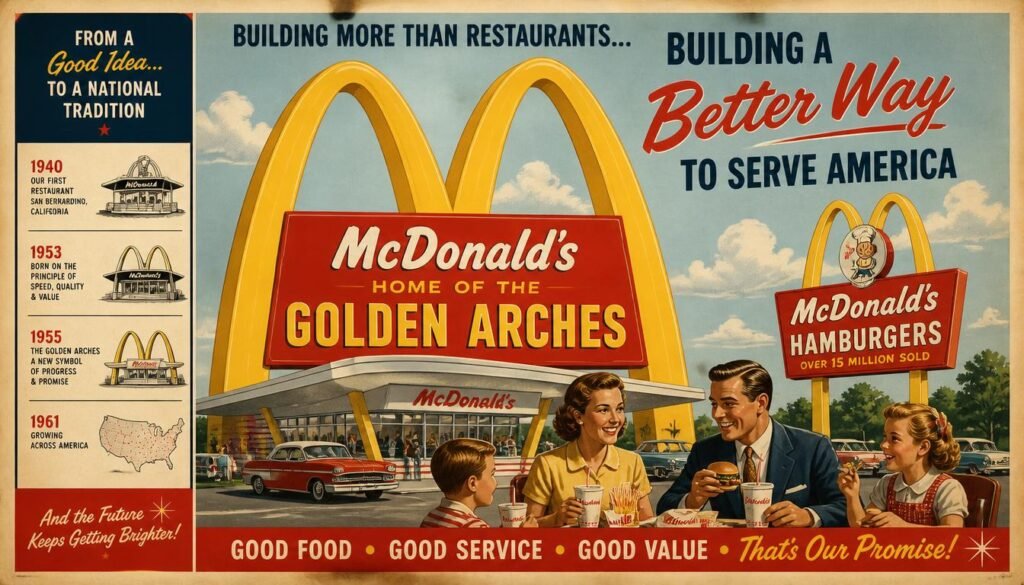
Architect Stanley Meston designed the now-iconic red and white building with its sweeping golden arches, a look that became instantly recognizable on roadsides across America.
Later, the company shifted toward the mansard roof design, softening the restaurant’s appearance to blend better into suburban neighborhoods as McDonald’s expanded into more residential areas.
Signage, too, evolved constantly. The glowing arches became shorthand for convenience, consistency, and a predictable meal no matter which town you happened to be passing through.
Menu Innovations That Made History
The original menu was simple: a 15 cent hamburger, fries, and a shake. But over the decades, franchisees themselves became unexpected inventors of some of the brand’s most beloved items.
Lou Groen, a franchise owner in Cincinnati with a largely Catholic customer base, created the Filet-O-Fish in 1962 to give people a meatless option on Fridays. It saved his struggling location.
Jim Delligatti, operating out of Pittsburgh, introduced the Big Mac in 1967. The double-decker burger became so iconic that its ingredients are practically recited like a nursery rhyme today.
The Quarter Pounder followed soon after, offering a bigger, juicier option for hungrier customers who wanted more than the standard-sized burger.
Breakfast arrived later than you might expect. Herb Peterson, a franchisee in Santa Barbara, invented the Egg McMuffin in 1973, essentially inventing the fast-food breakfast category as we know it.
Chicken McNuggets hit menus in 1983, followed by the McFlurry in the 1990s, both becoming permanent fixtures loved by kids and adults alike.
The Drive-Thru Revolution
McDonald’s introduced the drive-thru concept in Arizona, near a military base where soldiers weren’t allowed to leave their vehicles in uniform. It solved a niche problem and then quietly reshaped the entire fast-food industry.
Today, the drive-thru accounts for a massive share of sales, proving that sometimes the smallest operational tweaks create the biggest long-term impact on a business.
Training an Army of Managers
To keep quality consistent across thousands of locations, McDonald’s opened Hamburger University in Elk Grove Village, Illinois, in 1961. Franchisees and managers could earn a playful but genuine Bachelor of Hamburgerology.
The training emphasized quality, service, and cleanliness, often abbreviated as QSC, a mantra that still guides restaurant operations decades later around the world.
Fred Turner, an early Kroc collaborator, helped formalize much of this operational discipline, ensuring a burger tasted the same whether you were in Ohio or Oregon.
Going Global, One Border at a Time
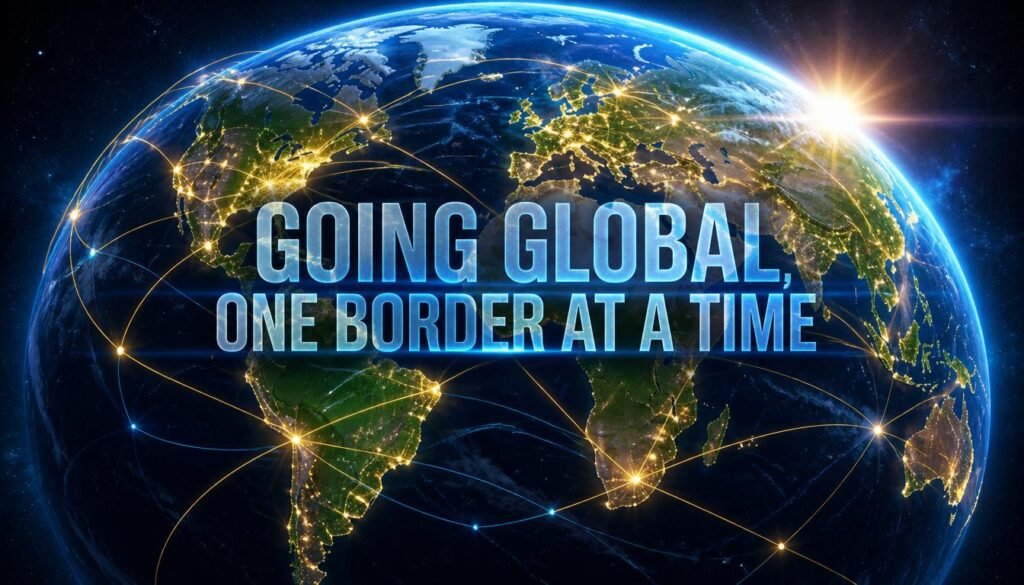
McDonald’s crossed into Canada and expanded steadily through the 1970s. Its most symbolic international opening came in 1990, when a location opened at Pushkin Square in Moscow, drawing roughly 30,000 customers on opening day.
Australia embraced the brand early too, with locations spreading through Melbourne, Victoria, and beyond. Germany, notably Munich, also became a strong European market for the company.
By the 2000s, McDonald’s operated in over 100 nations, feeding people breakfast, lunch, and dinner in dozens of languages and currencies simultaneously.
Beyond Burgers: Philanthropy and Community
In 1974, Fred Hill, a Philadelphia Eagles player whose daughter battled leukemia, helped inspire the creation of the first Ronald McDonald House. It gave families a place to stay near hospitals while children received treatment.
That single house in Philadelphia, Pennsylvania, grew into a global charitable network, supporting families during some of the hardest moments of their lives, far removed from burgers and fries.
Sustainability and the Restaurant of the Future
McDonald’s has increasingly leaned into environmental responsibility, experimenting with net zero-designed restaurants that generate their own energy on-site through renewable sources.
The company also began publishing a Social Responsibility Report, tracking commitments around sourcing, packaging, and energy use, a shift reflecting changing customer expectations.
Marketing That Stuck in Culture
Few taglines are as globally recognized as “i’m lovin’ it,” launched in 2003. It replaced decades of shifting slogans with one consistent, upbeat identity across every market the brand touched.
McDonaldland characters, playful advertising, and family-friendly branding helped cement the company not just as a restaurant, but as a piece of shared pop culture memory for generations of children.
The Digital and Delivery Era
As habits shifted, McDonald’s adapted again. Partnerships with services like UberEATS brought McDelivery into the smartphone age, letting customers order without ever stepping outside.
Global McDelivery Day became a promotional event celebrating this shift, while McCafé expanded the menu into coffee and espresso drinks, competing directly with coffeehouse chains.
All Day Breakfast, launched in 2015, finally gave customers what they’d been requesting for years: Egg McMuffins available well past the traditional morning cutoff.
A Legacy Still Being Written

From a single stand in San Bernardino to tens of thousands of restaurants worldwide, McDonald’s history is really a story about relentless small improvements. A faster kitchen system. A meatless sandwich for a struggling franchisee. A drive-thru built for soldiers.
None of these moments looked like history in the making at the time. Yet together, they built one of the most recognizable brands on the planet, proving that big legacies are often just a series of small, practical decisions, made by ordinary people trying to solve everyday problems.
Read more: https://menupricesaustralia.com/plain-bagel-with-regular-cream-cheese/
Frequently Asked Questions
first mcdonald’s
The first McDonald’s was opened by Dick and Mac McDonald in San Bernardino, California, in 1940 as a drive-in restaurant. Ray Kroc later opened the first franchised McDonald’s under the Speedee Service System in Des Plaines, Illinois, on April 15, 1955.
mcdonald’s history
McDonald’s began in 1940 as a small drive-in restaurant founded by the McDonald brothers, later transformed by Ray Kroc into a global franchise. Today it operates over 36,000 restaurants in more than 100 countries worldwide.
history of mcdonald’s
McDonald’s history traces back to 1940 when Dick and Mac McDonald introduced their innovative Speedee Service System. Ray Kroc joined in 1954, acquired full rights in 1961, and expanded the brand into a worldwide fast-food giant.
the first mcdonald’s
The very first McDonald’s restaurant opened in 1940 at Fourteenth and E Streets in San Bernardino, California. It started as a typical drive-in with car hop service before becoming a self-service restaurant in 1948.
when did mcdonald’s open
McDonald’s originally opened in 1940 in San Bernardino, California, as McDonald’s Bar-B-Q. The first Ray Kroc-operated McDonald’s, which sparked global franchising, opened on April 15, 1955, in Des Plaines, Illinois.


