

Training & Perks: How McDonald’s Builds Skills, Careers, and Confidence
There is something slightly funny about a first job. You arrive thinking you are only going to learn how to do the job, and then, somewhere between a busy lunch rush and a conversation with a manager, you realise you are learning how to deal with people, pressure, mistakes, time, and yourself too.
That is where Training & Perks becomes more than a catchy workplace phrase. For many employees, especially young people and students, a job can become a small classroom disguised as a restaurant.
At McDonald’s Canada, the workplace is built around more than serving food quickly. The company describes opportunities for employee training, learning, education support, recognition and career development, with programs intended to help people grow whether they stay for a short period or build a longer career.
Its current careers information also highlights flexible work for students, scholarships, benefits and recognition programs.
And perhaps that is the interesting part. A restaurant shift ends when the doors close, but the things a person learns during that shift can follow them into a completely different industry.
Communication doesn’t stay behind the counter. Time management doesn’t clock out. Confidence certainly doesn’t.
| Area | Short Details |
|---|---|
| Training | On-the-job training and digital learning |
| Skills | Customer service, teamwork, communication |
| Career Growth | Opportunities for promotion and leadership |
| Employee Perks | Discounts, flexible schedules, and benefits |
| Confidence | Builds responsibility and workplace experience |
| Development | Coaching, mentoring, and career support |
Why Training & Perks Matter More Than They First Appear
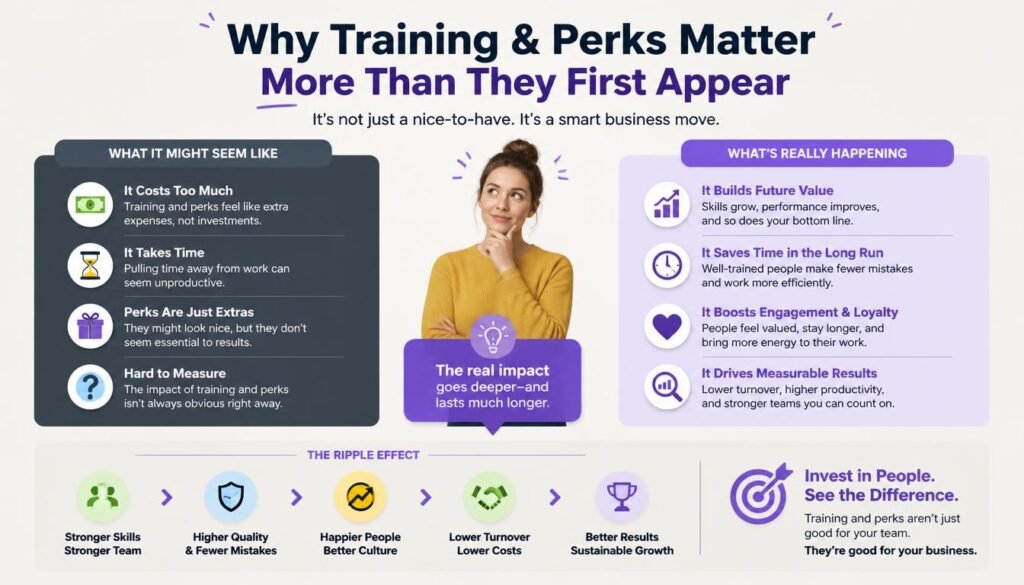
A good workplace does not merely tell someone what to do; it shows them how to become better at doing it.
That distinction is small on paper and enormous in real life, kinda like the difference between being handed a map and actually knowing how to walk the road.
Employee training can teach technical procedures, but strong workplace learning also develops habits that employers in almost every sector value.
Teamwork, communication, responsibility, problem solving, guest service and time management are not skills belonging only to the restaurant industry. They travel remarkably well.
McDonald’s Canada says employees can develop skills such as teamwork, leadership, agility, resilience and decision-making, and has described training and education as important parts of employee growth.
A company-published survey also reported that more than 60% of former McDonald’s workers surveyed said they still use skills learned there in their careers.
That makes a first job rather less “just a first job” than people sometimes assume.
A student who learns to communicate with ten different personalities during one shift is practicing communication. A crew member who figures out how to keep priorities straight when everything suddenly gets busy is practicing pressure management.
Someone who helps a new colleague learn the ropes is quietly practicing coaching and mentoring, even if nobody gives the activity such a grand name.
McDonald’s Training & Perks for Everyday Employees
The most useful kind of training is often the kind you barely notice while it is happening. You learn by doing, correcting, asking questions, trying again, and eventually showing someone else how it works.
McDonald’s describes a training environment where employees can gain practical experience and develop skills through their work. On-the-job learning matters because restaurant work has a rhythm that cannot be fully understood from a handbook.
The pace changes. Guests ask unexpected things. Teams have to communicate without turning every decision into a meeting, thankfully.
Here are some of the less obvious lessons that workplace training can provide:
- Communication skills grow when employees learn to listen carefully and explain things clearly, especially during busy periods.
- Guest service teaches people that good service is often about noticing what another person needs before they say it.
- Teamwork becomes practical rather than theoretical when several people have to coordinate toward one result.
- Time management develops naturally when tasks have to be completed within real operational deadlines.
- Problem solving becomes sharper because restaurant situations rarely arrive in perfectly labelled boxes.
- Accountability develops when employees understand that their individual actions affect colleagues and guests.
- Creative thinking has room to appear when teams face unexpected operational challenges.
- Leadership skills can begin developing long before someone receives a manager’s title.
- Responsibility becomes tangible because other people depend on you to do your part.
- Workplace confidence tends to grow through repetition, feedback and small wins that don’t look dramatic at first.
These are transferable skills, and that phrase is worth underlining. A person may eventually work in healthcare, technology, retail, education, finance or a small business, but knowing how to listen, cooperate and make decisions under pressure remains useful.
From Crew Member to Future Leader
One of the more interesting features of career development is that it does not always begin with a grand ambition. Sometimes somebody simply does the next thing well.
A crew member becomes a crew trainer. A crew trainer begins helping others. A person discovers that they enjoy team leadership. A manager notices potential.
Then suddenly the employee who once wondered whether they could handle a busy shift is learning about people management and restaurant performance.
McDonald’s Canada says its people-development approach is intended to provide employees with tools and opportunities to succeed, from newer employees through senior management.
It also highlights career-development opportunities and describes examples of leaders who began their careers as Crew members.
This is why leadership development should not be viewed only as something for executives. Leadership can begin with small behaviours:
helping someone without being asked, keeping a team calm, accepting responsibility for a mistake, giving useful feedback, or making sure a quieter colleague gets heard.
Those behaviours become the raw material for bigger leadership opportunities later.
And yes, sometimes leadership is simply remembering that everyone needs a break and not pretending the shift will magically become easier because you have stared at the clock for six minutes.
Training & Perks for Restaurant Managers
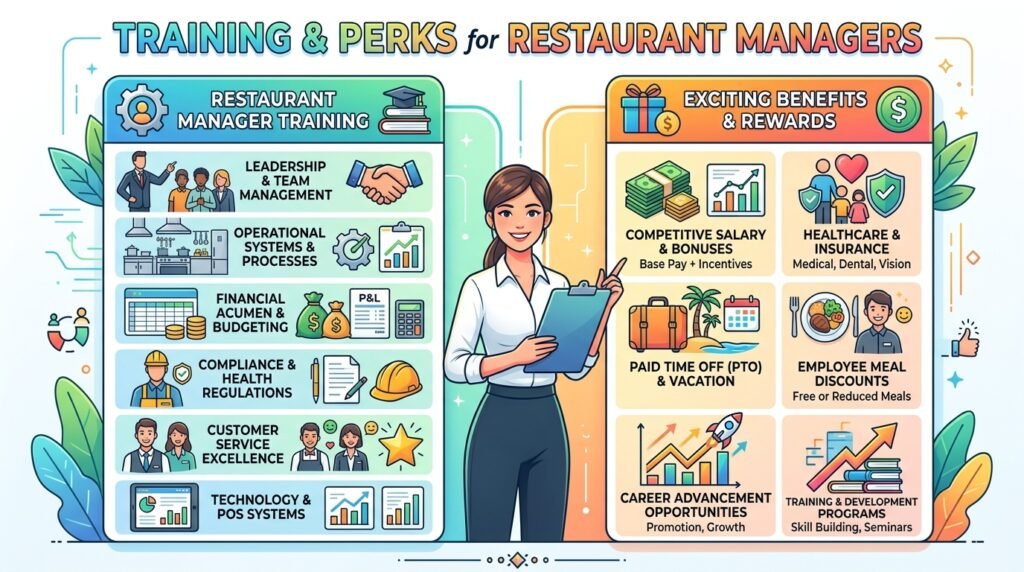
The responsibilities become broader when an employee moves into management. Now the focus is no longer only on completing individual tasks.
A manager has to think about people, standards, customer experience, staffing, performance, business needs and the overall health of the restaurant.
This is where restaurant manager training and management training become especially valuable.
The management side of restaurant work can involve:
- Restaurant operations and daily planning
- People leadership and team development
- Performance management
- Performance reviews
- Employee engagement
- Talent development
- Business planning
- Food quality management
- Guest experience
- Sales performance
- Profit improvement
- Operational excellence
- Restaurant improvement planning
- Accountability and goal setting
A manager therefore needs a wider toolkit than somebody might imagine from the outside. They need to understand the operation, certainly, but also the humans inside it. Numbers can tell you what happened. People can often tell you why it happened.
McDonald’s Canada also describes leadership and development as part of its broader people strategy, including opportunities for employees to grow their careers and access mentoring, networking and advancement opportunities.
That combination matters because a technically excellent restaurant with an unhappy, disconnected team is not really operating excellently. It is merely surviving with good lighting.
Learning Business Leadership, Not Just Restaurant Tasks
There is a second layer to workplace development that deserves more attention: business leadership.
Someone working toward management may learn that restaurant performance is connected to many moving pieces. Staffing affects service. Service affects guest experience.
Guest experience can affect sales. Training affects consistency. Consistency affects operational performance. It is a chain, and every link has a person standing somewhere inside it.
That is why concepts such as business planning, goal setting, performance management and operational decision-making become valuable.
For employees interested in a future corporate career, this can be particularly useful. Restaurant experience can provide an early understanding of how large organisations actually function at ground level, where strategies eventually become actions carried out by real people during real shifts.
It is not glamorous every minute. That’s probably why it teaches so much.
Training & Perks for Students and Young Workers
For students, the biggest workplace perk can sometimes be flexibility itself.
Schoolwork does not politely disappear because a workplace needs staff. Exams arrive. Assignments multiply. Family commitments happen. Life, inconveniently, continues outside the schedule.
McDonald’s Canada says it works with employees to help balance work and studies, and reports that it employs tens of thousands of young people with flexible scheduling designed to fit around school, extracurricular activities and family responsibilities.
That makes student employment an important part of the conversation.
A student job can provide:
- Work-study balance experience
- Student employment and workplace exposure
- Practical time management
- Early career training
- Income and earning experience
- Transferable skills
- Exposure to team leadership
- Opportunities for career advancement
- A chance to build references and workplace confidence
- Access to potential scholarships
The last point is especially meaningful.
Scholarships and Education Support

A paycheck can help someone today. Education support can potentially change what becomes possible tomorrow.
McDonald’s Canada says its long-standing scholarship program has operated for more than 25 years and that more than 4,000 McDonald’s employees have shared scholarship awards totalling more than $2 million since the program began, according to its Training & Perks information.
That turns scholarships into more than a decorative benefit on a careers page. For an employee trying to manage tuition, books and ordinary life expenses, educational assistance can feel very concrete.
It also sends an unusual message to a young worker: what you are doing in school matters here too.
The broader company information now also highlights Archways to Opportunity partnerships with universities and colleges across Canada, while McDonald’s Canada describes additional education and bursary initiatives.
Education support does not guarantee a particular career outcome, of course. But it can reduce one barrier between ambition and opportunity, and sometimes reducing one barrier is exactly what a person needs.
Employee Benefits That Go Beyond the Paycheque
Compensation is important. Nobody pays their electricity bill with inspirational leadership quotes, sadly.
But total compensation can involve more than wages alone. McDonald’s Canada says Crew, Restaurant Managers and full-time employees may be eligible for different benefits and rewards, including competitive starting rates, wage and performance reviews, free uniforms for restaurant staff and various discounts. Eligibility varies by role and employment circumstances.
For eligible full-time employees, the company says its Comprehensive Group Insurance Plan includes extended health, dental, disability and life insurance for employees and their families.
The important lesson for job seekers is to look beyond a headline wage.
When comparing opportunities, consider the complete employee benefits picture:
- Starting rates and potential wage increases
- Performance reviews
- Competitive pay
- Employee discounts
- Uniform support
- Health benefits
- Dental coverage
- Disability protection
- Life insurance
- Family coverage where applicable
- Education support
- Scholarships
- Training and career-development opportunities
Benefits vary according to employment status and the particular restaurant or franchise arrangement, so applicants should always confirm the current details with the employer.
McDonald’s Canada also notes that many Canadian restaurants are independently operated franchises, meaning employment terms can depend on the specific employer.
That little detail is important, and often skipped.
Recognition: Why Being Noticed Can Matter
There is a peculiar human need to know that our effort was seen.
Money matters, promotions matter, opportunities matter. But sometimes a sincere “you handled that really well” lands in a different place altogether.
McDonald’s Canada says its employee recognition approach includes appreciation for hard work, dedication, motivation and results.
Recognition can range from everyday thanks to programs such as Employee of the Month, management leadership awards and the Ray Kroc Awards.
The company says the Ray Kroc Awards recognise outstanding restaurant management performance, with the top 1% of Restaurant Managers honoured each year.
Recognition can help reinforce behaviours a workplace wants to see repeated.
A team member who is recognised for helping a new employee may become an even stronger mentor.
A manager recognised for team development may understand that people leadership is valued just as much as operational numbers.
This is where employee rewards and recognition programs overlap with motivation.
Not every employee wants a trophy. Some want more responsibility. Some want a thank-you. Some want a schedule that works with school. Others want a promotion. Good recognition understands that appreciation has more than one shape.
The Human Side of High-Performing Teams

A high-performing team is not simply a group of people moving quickly.
Speed without communication creates confusion. Accountability without trust creates fear. Leadership without listening creates distance.
And teamwork without respect is basically five people pushing the same shopping cart in different directions.
Strong teams depend on employee engagement, communication and shared responsibility.
Managers and crew trainers can influence this by setting clear expectations, providing feedback and creating a positive coaching environment.
Employees, meanwhile, contribute through reliability, cooperation, curiosity and the willingness to help others.
This is why coaching can be more powerful than criticism. A mistake tells you what went wrong. Good coaching helps someone understand what to do differently next time.
That difference may sound tiny. It isn’t.
Recognition, Awards, and the Feeling of Progress
Work becomes easier to value when employees can see progress.
That progress might be a new skill, a higher level of responsibility, stronger guest-service ability, improved performance, an academic achievement or simply becoming the person others trust during a difficult shift.
McDonald’s Canada connects recognition with hard work and results through programs including Employee of the Month and leadership awards, while the Ray Kroc Awards provide recognition at the restaurant-management level.
There is also a broader community dimension. McDonald’s Canada describes relationships with local communities and initiatives supporting education, youth and community organisations, meaning that community achievement can sit alongside workplace development rather naturally.
For some employees, that connection is meaningful because employment becomes more than a private transaction between worker and company. It becomes a way of participating in the place where they live.
How to Make the Most of Training & Perks
A benefit only becomes useful when a person actually knows how to use it.
If you are considering a McDonald’s role, do not be shy about asking practical questions during the hiring process.
Ask what training is provided, how schedules work, what benefits apply to your role, whether education programs are available, and what paths exist for advancement.
If you are already an employee, keep a small mental list of skills you are building.
Maybe you are getting better at guest service. Maybe you have started training others. Maybe your communication has improved.
Maybe you have learned how to manage a team when everyone is tired and the queue appears to have developed its own ecosystem.
Write those things down.
They can later become examples in a résumé, interview or performance conversation.
And if management interests you, tell somebody. Career development rarely works through mind-reading. Managers can only help develop potential that they know exists.
Training & Perks Can Become a Career Foundation
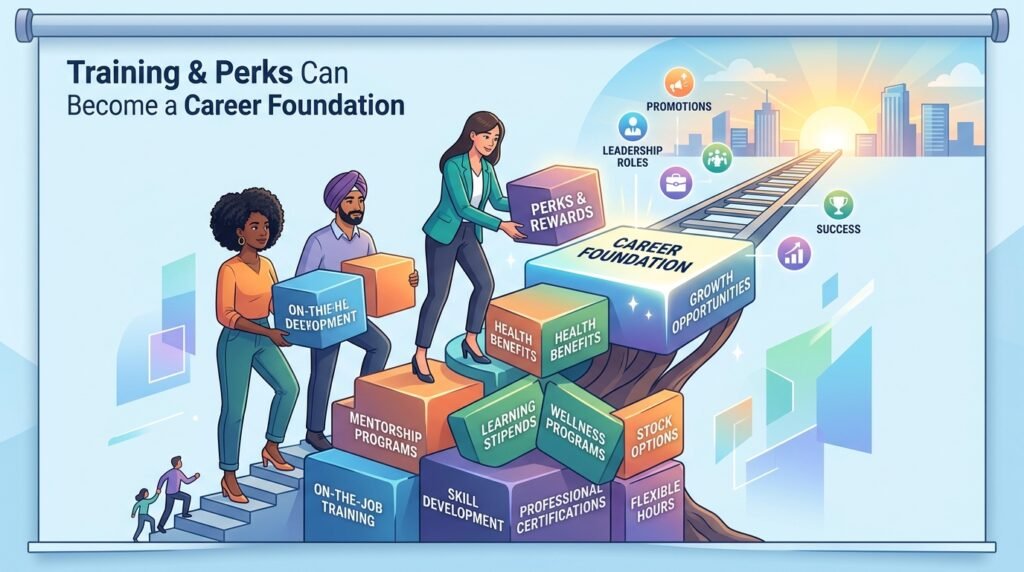
Not everybody who joins a restaurant wants a lifelong career in restaurants, and that is completely fine.
A good first job can still be valuable even when the destination is somewhere else.
The skills developed through employee development, workplace training and practical responsibility can become part of a broader professional identity.
Someone might leave for college, start a business, enter an office career or move into another industry. The experience does not vanish simply because the uniform is no longer being worn.
McDonald’s Canada itself points to employees building skills that can support future employment and says its career approach is designed to support people whether they are seeking a year of work or a longer-term career.
That is perhaps the strongest way to understand Training & Perks.
Training is what you learn.
Perks are what support you.
Recognition is what reminds you that your contribution matters.
Career development is what can happen when all three meet a motivated person at the right moment.
Frequently Asked Question
mcdonald’s employee benefits
McDonald’s employee benefits can include flexible scheduling, employee discounts, training opportunities, and access to benefits that may vary by role and location. These options can make the job more practical for both part-time and full-time workers.
mcdonalds perks
Some McDonald’s perks include flexible work hours, crew discounts, career development opportunities, and a chance to gain useful customer-service and teamwork skills while working.
mcdonald’s perks
Working at McDonald’s may come with perks such as meal discounts, flexible shifts, employee recognition, and opportunities to move into higher positions as you gain experience.
benefits of working at mcdonalds
The benefits of working at McDonald’s can go beyond a paycheck, offering workplace experience, flexible schedules, training, and opportunities to build skills that can be useful in future careers.
mcdonalds employee benefits
McDonald’s employee benefits vary depending on the employee’s position, employment status, and location, but may include discounts, scheduling flexibility, training programs, and other workplace benefits.
Read this blog https://menupricesaustralia.com/mcchicken/
A Final Thought on Work That Follows You
The most valuable thing a person takes from a job is not always printed on a pay statement.
Sometimes it is the confidence to speak to a stranger. Sometimes it is learning how to recover gracefully after making a mistake. Sometimes it is discovering that you actually enjoy leading people.
Sometimes it is the scholarship that helps keep a student in school. Sometimes it is simply realizing, perhaps for the first time, that you are capable of handling more than you thought.
That is the quiet power of employee training and genuine development.
For McDonald’s Canada, the published approach combines career opportunities, education support, benefits, workplace learning and employee recognition across different stages of an employee’s journey.
The precise perks and eligibility can vary, particularly because many Canadian restaurants are independently operated franchises, so checking the current terms for a specific location is always the sensible move.
But the larger idea is easy to understand.
A job can give you a wage. A good learning environment can give you skills. A supportive manager can give you confidence. A scholarship can give you another academic door to walk through. Recognition can remind you that somebody noticed the work.
And sometimes, years later, you discover that the busiest shift you thought you were merely surviving was actually teaching you how to build a career.
That is a pretty useful perk, even if nobody puts it on the uniform.


